
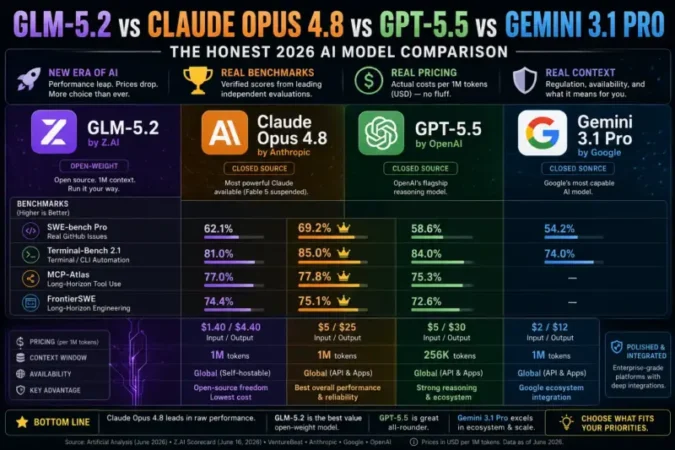
The GLM-5.2 vs Claude Opus 4.8 comparison is the most important model decision of mid-2026. Something genuinely unusual happened in June 2026. An open-weight model from a Beijing-based lab beat OpenAI’s GPT-5.5 on multiple coding benchmarks while costing roughly one-sixth as much per token. And it did it in the same week that Anthropic’s most powerful model was suspended by a US government export order.
If you’re trying to figure out which AI model to actually use right now, the answer has gotten more complicated and more interesting at the same time. This comparison cuts through the launch-day marketing and looks at what each model actually delivers, verified across multiple independent sources.
The Context Worth Knowing First
Before any benchmark, one fact shapes this entire comparison: Claude Fable 5, Anthropic’s most capable model, is currently unavailable. As we covered in our full breakdown of the Fable 5 export control suspension, the US government ordered Anthropic to take both Fable 5 and Mythos 5 offline in June 2026 for all users worldwide. The Claude in this comparison is therefore Claude Opus 4.8 Anthropic’s best model actually available today.
Separately, the SK Telecom connection and “fix this code” jailbreak that triggered the ban remain unresolved. That regulatory backdrop matters for teams evaluating long-term model dependency a point we’ll return to.
The Models at a Glance
| Model | Provider | Type | Input Price | Output Price | Context |
|---|---|---|---|---|---|
| GLM-5.2 | Z.AI | Open-weight | $1.40/M | $4.40/M | 1M tokens |
| Claude Opus 4.8 | Anthropic | Closed | $5/M | $25/M | 1M tokens |
| Gemini 3.1 Pro | Closed | $2/M | $12/M | 1M tokens | |
| GPT-5.5 | OpenAI | Closed | $5/M | $30/M | 256K tokens |
Three things jump out immediately. First, GLM-5.2 is dramatically cheaper than every closed model roughly 5x to 7x cheaper on output tokens than Claude Opus 4.8, and about one-sixth the cost of GPT-5.5 per VentureBeat’s analysis. Second, GPT-5.5 has the smallest context window of the four at 256K tokens a real constraint for large codebase analysis. Third, all four offer a 1M token context window except GPT-5.5, which matters for long-document analysis and large-scale coding tasks.
Benchmarks: Who Actually Wins What
Rather than a single winner-take-all ranking, here is what each model genuinely leads on, based on verified data from Artificial Analysis, Z.AI’s June 16 scorecard, VentureBeat’s independent analysis, and Anthropic’s published benchmarks.
Agentic Coding SWE-bench Pro (Real GitHub Issues)
This is the benchmark that most closely predicts real-world software engineering performance, because tasks require navigating actual codebases and producing fixes that pass existing tests.
Claude Opus 4.8:  69.2%  ← WINNER
GLM-5.2:          62.1%
GPT-5.5:          58.6%
Gemini 3.1 Pro:   54.2%
Claude Opus 4.8 leads clearly. What’s genuinely surprising is that GLM-5.2 beats both GPT-5.5 and Gemini 3.1 Pro a Chinese open-weight model outperforming OpenAI’s flagship on the hardest software engineering benchmark, at a fraction of the cost. According to VentureBeat’s coverage of the GLM-5.2 release, Z.AI’s model achieves this performance while being price-competitive with models two to three capability tiers below it.
Terminal and CLI Automation – Terminal-Bench 2.1
This measures autonomous terminal task completion the kind of work that powers DevOps automation, CI/CD pipelines, and shell scripting agents.
Claude Opus 4.8:  85.0%
GPT-5.5:          84.0%
GLM-5.2:          81.0%
Gemini 3.1 Pro:   74.0%
Claude and GPT-5.5 are effectively tied here. GLM-5.2 at 81.0% is four points behind Opus 4.8 a genuine gap but not a disqualifying one for most terminal workflows. Gemini 3.1 Pro trails more significantly on this benchmark.
Long-Horizon Agentic Tool Use – MCP-Atlas
This benchmark tests Model Context Protocol tool orchestration how well a model sequences multi-step tool calls across extended sessions.
Claude Opus 4.8:  77.8%  ← WINNER
GLM-5.2:          77.0%
GPT-5.5:          75.3%
The gap between GLM-5.2 and Claude Opus 4.8 here is under one percentage point. For all practical agentic tool-use purposes, these two models are peers. GPT-5.5 trails both.
FrontierSWE – Long-Horizon Engineering Tasks
Claude Opus 4.8:  75.1%
GLM-5.2:          74.4%  ← within 1 point
GPT-5.5:          72.6%
Again, GLM-5.2 and Opus 4.8 are within 1% of each other on this benchmark. GPT-5.5 trails both by about 2.5 points.
Knowledge Work – GDPval-AA
Claude Opus 4.8:  1890 Elo  ← WINNER
GPT-5.5:          1769 Elo
Gemini 3.1 Pro:   1314 Elo
GLM-5.2:          Not published
For professional knowledge work – legal review, financial analysis, research synthesis Claude Opus 4.8’s lead is substantial. This benchmark matters most for enterprise teams doing judgment-heavy document work, the kind of tasks where a missed implication in a contract clause has real consequences.
The Pricing Gap Is the Real Story
Benchmarks are the what. Pricing is the whether. In the GLM-5.2 vs Claude Opus 4.8 debate, pricing is where the gap becomes impossible to ignore. At 50 million tokens per month a reasonable production workload here is what each model costs with a 50/50 input/output split:
GLM-5.2:          $145/month
Gemini 3.1 Pro:   $350/month
Claude Opus 4.8:  $750/month
GPT-5.5:          $875/month
GLM-5.2’s MIT license also means you can self-host it entirely, paying only for compute which removes per-token cost completely for teams with the GPU infrastructure. The weights require a substantial server (approximately 8x H100-class GPUs to serve in production), but for teams processing millions of tokens daily, the economics of self-hosting improve rapidly.
For Indian developers and growing startups evaluating these tools, GLM-5.2’s flat $10/month GLM Coding Plan entry tier is worth noting it’s the most accessible path to near-frontier coding performance available in 2026, comparable in structure to the GitHub Copilot pricing shift we analyzed in our complete GitHub Copilot pricing breakdown.
Where Each Model Genuinely Wins
Choose Claude Opus 4.8 when: Your work is the hardest kind of software engineering long autonomous agent runs, complex multi-file refactors, NL2Repo tasks, or any situation where a model going silently off-track costs real time and money. Opus 4.8 also leads significantly on professional knowledge work (GDPval-AA Elo 1890 vs GPT-5.5’s 1769), making it the strongest choice for legal, financial, and research document analysis. Anthropic’s Fast Mode which cut one team’s median response time from 2.8 seconds to 1.2 seconds with no quality regression adds a latency advantage for interactive applications.
Choose GPT-5.5 when: You need a strong generalist with the broadest third-party ecosystem, or when your work is heavily terminal-based and CLI-driven. GPT-5.5 and Claude Opus 4.8 are effectively tied on Terminal-Bench 2.1 (84.0% vs 85.0%), making it the better choice when tool ecosystem breadth matters alongside terminal performance. The 256K context limitation is a real constraint for codebase-wide tasks, but GPT-5.5’s native omnimodality handles mixed-input workflows cleanly.
Choose Gemini 3.1 Pro when: You’re embedded in Google’s ecosystem — Workspace, Cloud, Firebase — or when multimodal document workflows are central. Gemini handles scanned PDFs, charts, and image-heavy documents better than the other three. Its $2/million input price is the cheapest closed-model option, though note that pricing roughly doubles above 200K tokens, which limits the cost advantage on truly long-context tasks.
Choose GLM-5.2 when: Cost-performance ratio is the primary consideration which is a legitimate, strategic decision rather than a budget compromise. On SWE-bench Pro (62.1%), FrontierSWE (74.4%), and MCP-Atlas (77.0%), GLM-5.2 is either beating or matching GPT-5.5 at one-sixth the price. Its MIT license and open weights mean no vendor lock-in, no data sent to US or European cloud infrastructure, and the option to self-host entirely. For teams doing AI-assisted coding at volume, GLM-5.2 changes the economics of what’s possible.
The vendor-lock-in angle deserves honest treatment, given what happened in June 2026. GLM-5.2’s MIT weights mean that once you’ve downloaded them, no government order, no corporate policy change, and no export restriction can take them offline for you. That’s a structural advantage that no closed model can replicate, and it’s a factor that teams building critical workflows on frontier AI should factor into their evaluation.
The Cost Per Benchmark Point A Different Way to Look at It
A more useful framing than raw benchmarks is value per dollar. Taking SWE-bench Pro as the reference benchmark:
Claude Opus 4.8: $0.362 output cost per benchmark point
GPT-5.5:         $0.511 output cost per benchmark point
Gemini 3.1 Pro:  $0.221 output cost per benchmark point
GLM-5.2:         $0.071 output cost per benchmark point
GLM-5.2 delivers approximately 5x more benchmark value per output dollar than Claude Opus 4.8, and more than 7x versus GPT-5.5. The question isn’t whether GLM-5.2 is the single best model it isn’t, on the hardest tasks. The question is whether the performance gap justifies the price multiple for your specific workload. For a majority of engineering tasks, it doesn’t.
The Routing Strategy Most Serious Teams Use
The smartest answer in 2026 isn’t picking one model. It’s routing. Most serious AI-powered development teams in 2026 run a tiered stack:
- Opus 4.8 for the hardest tasks complex multi-file refactors, long agentic runs, high-stakes professional output
- GLM-5.2 for high-volume coding, long-context analysis, and cost-sensitive work where near-frontier performance is sufficient
- Gemini 3.1 Pro for multimodal and Google-ecosystem tasks
- GPT-5.5 for terminal-heavy automation and broad generalist tooling
This kind of routing matching model to task rather than running everything through the most expensive model typically reduces AI infrastructure costs by 40–60% with no meaningful quality loss on individual tasks. As we detailed in our breakdown of the best open source coding models, this pattern of combining open and closed models is now standard practice among teams that have moved past the “which model is best” framing entirely.
Frequently Asked Questions
Is GLM-5.2 really better than GPT-5.5 at coding? On SWE-bench Pro the most cited benchmark for real-world software engineering yes. GLM-5.2 scores 62.1% versus GPT-5.5’s 58.6%. On Terminal-Bench 2.1, GPT-5.5 leads (84.0% vs 81.0%). It depends on the specific task, but for coding benchmark performance per dollar, GLM-5.2 is not close to GPT-5.5 it’s dramatically better value.
Does Claude Opus 4.8 still lead in 2026? On the hardest tasks SWE-bench Pro (69.2%), NL2Repo, and GDPval-AA knowledge work (1890 Elo) yes, Opus 4.8 remains the strongest available model. Fable 5 was more capable but is currently suspended. Opus 4.8 is the practical frontier for most teams.
Is GLM-5.2 safe to use for production workloads? For non-sensitive coding and analysis tasks via the hosted API, yes independent benchmarks confirm the performance numbers hold. For sensitive data, self-hosting the MIT-licensed weights removes the data-sharing concern entirely. Teams in regulated industries should evaluate the self-hosted option carefully given Z.AI’s China-based operations and the National Intelligence Law considerations that apply to cloud API usage.
What is the cheapest way to access frontier-level AI in 2026? GLM-5.2’s Go plan at $10/month is the most accessible entry point for near-frontier coding performance. Gemini 3.1 Pro at $2/million input tokens is the cheapest closed-model API. For truly budget-constrained teams, Gemini CLI offers 1,000 free requests per day for light use.
Does Gemini 3.1 Pro support a 1M token context? Yes, but with a pricing caveat: the $2/million input rate applies below 200K tokens. Above 200K tokens, pricing approximately doubles making the cost profile less favorable than it initially appears for truly long-context workloads.
Benchmark data sourced from Artificial Analysis’s June 2026 Intelligence Index, Z.AI’s June 16, 2026 scorecard, VentureBeat’s independent analysis, Pristren’s comparative testing, and Anthropic’s published Opus 4.8 benchmarks. Pricing reflects official vendor API documentation as of late June 2026. All vendor-reported benchmarks are noted as such results vary by harness and evaluation methodology. Verify current pricing directly with each provider before production decisions.