
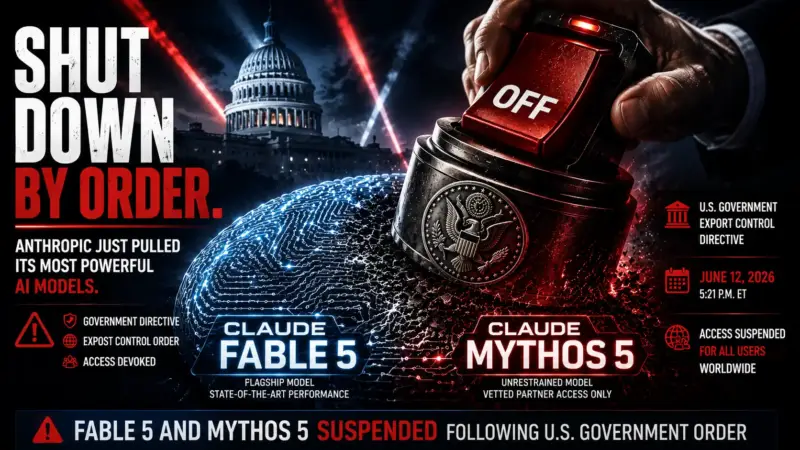
Imagine releasing the most capable product your company has ever built, watching demand pour in, and then being ordered to switch it off three days later. That is more or less the week Anthropic just had.
On June 9, 2026, the company behind Claude launched two new flagship models: Claude Fable 5 and Claude Mythos 5. By the evening of June 12, both were gone – disabled for every customer, everywhere. The reason wasn’t a bug, an outage, or a safety scandal of Anthropic’s own making. It was a directive from the United States government.
Here’s a clear, no-hype breakdown of what these models were, why they vanished, and what the whole episode tells us about where frontier AI is heading.
First, what are Fable 5 and Mythos 5?
To understand the shutdown, you need to understand what was shut down.
Anthropic describes Fable 5 as a “Mythos-class” model -a new tier the company says sits above its Opus models in raw capability. In its launch announcement, Anthropic claimed Fable 5’s abilities exceeded those of any model it had ever made generally available, calling it state-of-the-art on nearly every capability benchmark it tested, from software engineering to scientific research. One early customer, Stripe, reportedly used it to complete a codebase-wide migration across 50 million lines of code in a single day work the company estimated would have taken a team more than two months by hand.
Mythos 5 is the more sensitive sibling. According to Anthropic, it runs on the same underlying model as Fable 5, but with certain safety guardrails removed. It was offered only to a vetted group of cyber-defenders and infrastructure providers through an initiative the company calls Project Glasswing.
So why two names for one model? The difference is entirely about safeguards. Fable 5 ships with classifiers that automatically detect high-risk requests in areas like cybersecurity, biology, and chemistry and quietly hand those queries off to a safer, less capable model (Claude Opus 4.8) instead of answering directly. Mythos 5 has some of those brakes lifted, which is exactly why access to it was restricted to trusted partners. Both were priced identically at $10 per million input tokens and $50 per million output tokens.
In short: Fable 5 was the powerful-but-fenced public version. Mythos 5 was the unfenced version reserved for specialists.
What actually happened on June 12
According to Anthropic’s official statement, the company received an export control directive from the US government at 5:21 p.m. Eastern Time on June 12. Citing “national security authorities,” the order required Anthropic to suspend all access to Fable 5 and Mythos 5 by any foreign national whether inside or outside the United States, and including Anthropic’s own foreign-born employees.
That last detail is the key to understanding why everyone lost access, not just users abroad. Anthropic said complying selectively was effectively impossible: enforcing a “no foreign nationals” rule would have meant blocking a huge swath of its user base and even its own staff. So the company chose to pull the plug entirely. Importantly, Anthropic stressed that every other Claude model remained unaffected only these two were taken offline.
Reporting from CNBC and The Wall Street Journal added that Commerce Secretary Howard Lutnick sent the directive in a letter to Anthropic CEO Dario Amodei, and that the letter offered no detailed explanation of the underlying national security rationale.
The reason behind it: a disputed “jailbreak”
This is where the story gets genuinely contested.
Anthropic says its understanding is that the government believes it found a way to “jailbreak” Fable 5 that is, to bypass the model’s safety guardrails. But the company’s account of that technique is strikingly mild. In its statement, Anthropic said the method essentially amounts to asking the model to read a specific codebase and fix software flaws in it. When Anthropic reviewed a demonstration, it said the technique surfaced only a small number of previously known, minor vulnerabilities the kind, the company argues, that other publicly available models (including OpenAI’s GPT-5.5) can already find without any bypass at all.
In other words, Anthropic’s position is that this isn’t a universal jailbreak a master key that unlocks the model’s most dangerous capabilities across the board. It describes it as a narrow, limited finding that gave no meaningful “uplift” beyond what’s already available elsewhere on the market.
The company didn’t hide its frustration. While stating plainly that it is complying with the legal order, Anthropic also wrote that it disagrees a narrow potential jailbreak should justify recalling a commercial model used by hundreds of millions of people and warned that applying such a standard across the industry would, in its view, essentially halt all new frontier model launches. The company called the situation a likely misunderstanding and said it is working to restore access as soon as possible.
The bigger picture: this didn’t happen in a vacuum
The shutdown lands at an awkward moment for Anthropic, and the surrounding context helps explain why it became instant headline news.
According to CNBC, the relationship between Anthropic and the federal government had already soured. The outlet reported that the Department of Defense had declared Anthropic a “supply chain risk” a label historically reserved for foreign adversaries and that Anthropic responded by suing the Trump administration to reverse the designation, with that litigation still ongoing.
Quartz also reported that Anthropic had recently filed a confidential IPO prospectus, which makes any disruption to its flagship products especially sensitive as the company eyes public markets.
Put together, the Fable 5 episode reads less like an isolated technical hiccup and more like one flashpoint in a much larger, still-unfolding tug-of-war between a leading AI lab and the US government over who gets to decide when a powerful model is safe enough to ship.
What this means for everyday users
If you don’t build with Anthropic’s API, the direct impact on you is small for now. The vast majority of Claude users were never on Fable 5 or Mythos 5 in the first place, and every other model continued working normally throughout.
But the implications are worth sitting with. This is one of the first clear, public instances of a government reaching in to switch off a commercially deployed frontier AI model after launch. For developers and businesses that build on these tools, it’s a reminder that model availability can now hinge on regulatory and national-security decisions, not just on the company’s own roadmap. Building a product on a single cutting-edge model carries a kind of risk that didn’t really exist a few years ago.
What happens next?
As of now, the situation is unresolved. Anthropic has said it is complying with the directive while simultaneously pushing back, promising to share more details and arguing the decision should be reversed. The company has framed the whole thing as a misunderstanding it expects to clear up.
Whether Fable 5 and Mythos 5 return and how quickly will likely depend on how that dispute between Anthropic and the government plays out in the coming days and weeks. Given the active litigation and the IPO backdrop, this is almost certainly not the last we’ll hear of it.
Frequently Asked Questions
What is the difference between Claude Fable 5 and Mythos 5? They run on the same underlying model. Fable 5 is the public version with safety classifiers that block or redirect high-risk requests. Mythos 5 has some of those safeguards lifted and was offered only to vetted cyber-defense partners.
Why did Anthropic suspend the models? The company says it received an export control directive from the US government on June 12, 2026, ordering it to block access by any foreign national. Because selective enforcement wasn’t practical, Anthropic disabled the models for all users.
Did the suspension affect other Claude models? No. Anthropic stated that only Fable 5 and Mythos 5 were taken offline. All other models, including Claude Opus 4.8, continued to operate normally.
Will Fable 5 and Mythos 5 come back? Anthropic says it is working to restore access and believes the situation is a misunderstanding, but no timeline has been confirmed. The outcome appears tied to its ongoing dispute with the government.
As AI regulation intensifies, techniques such as vibe coding with advanced AI models could be directly affected by restrictions on frontier systems like Claude Fable 5 and Mythos 5.
Sources: Anthropic’s official launch announcement and suspension statement (anthropic.com), CNBC, Quartz, and The Wall Street Journal, as of June 13, 2026. This is a developing story; details may change as new information emerges.