
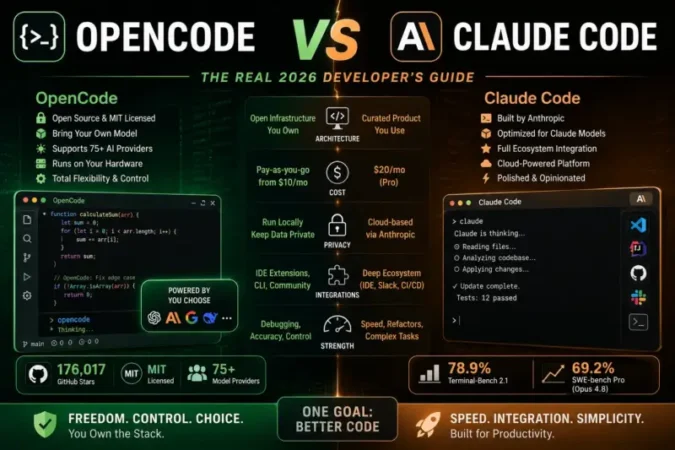
Most comparisons between OpenCode and Claude Code miss the real question. They debate which tool writes cleaner code or has a better terminal experience. Those are surface-level differences.
The actual question is architectural: do you want an AI coding agent that is a curated product locked to one model family, or do you want agent infrastructure you own, can inspect, and can point at any model you choose including one running on your own hardware?
That architectural choice changes everything downstream, including cost, privacy, and how you respond when a vendor decides to block third-party access. Which is exactly what happened in January 2026.
What Each Tool Actually Is
OpenCode is an open-source, MIT-licensed AI coding agent built as a terminal user interface that also ships a desktop app and IDE extensions. It is the community’s answer to Claude Code. OpenCode is a bring-your-own-model platform it provides the tools for editing, terminal execution, and git management, but allows you to choose the model you want to use. That means Claude, GPT-5.5, Gemini, DeepSeek, GLM-5.2, or a local model running through Ollama on your own hardware. OpenCode has 176,017 GitHub stars, MIT licensed, and supports 75-plus model providers.
Claude Code is Anthropic’s official terminal-native coding agent, exclusively built around Claude models. Claude Code optimizes for Anthropic’s full coding agent platform. You can find Claude Code’s full details on Anthropic’s official page. It spans terminal, VS Code, Cursor, JetBrains, desktop, web, iOS handoff, Slack, GitHub Actions, and GitLab CI/CD. Where OpenCode gives you infrastructure to configure, Claude Code gives you a polished, opinionated product with strong defaults and deep integration across Anthropic’s ecosystem.
The January 2026 Incident That Defined the Split
Understanding the current state of these tools requires knowing what happened on January 9, 2026. Anthropic silently blocked OpenCode from using Claude via consumer OAuth tokens. OpenCode removed Claude Pro/Max support from the codebase, citing “anthropic legal requests.” The developer backlash across tech forums was immediate and fierce.
This wasn’t a minor incident. Developers who had been using their existing Claude Pro subscriptions with OpenCode found the connection severed overnight without warning. OpenCode responded by launching Black ($200/mo, sold out), Zen (pay-as-you-go curated gateway), and most recently Go ($10/mo for open-weight models like GLM-5.2, Kimi K2.5, DeepSeek V4). OpenAI publicly welcomed third-party tools as counter-positioning.
The aftermath was a genuine community split. Developers who valued provider freedom rallied around OpenCode. Developers who wanted the tightest possible model integration stayed with Claude Code. Five months later, both sides doubled down.
One important fact developers should know: per OpenCode’s docs, Anthropic explicitly prohibits using Claude Pro or Max subscriptions with third-party tools like OpenCode. ChatGPT Plus, GitHub Copilot, and GitLab Duo subscriptions are usable as model backends. If you want to use Claude models with OpenCode today, you need direct Anthropic API access not a consumer Claude subscription.
Benchmarks: What the Numbers Actually Show
On the public Terminal-Bench 2.1 leaderboard, Claude Code with Opus 4.8 scores 78.9%. For the SWE-bench Pro benchmark measuring real GitHub issue resolution, Claude Code with Opus 4.8 achieves 69.2%.
OpenCode doesn’t have its own benchmark score and this is a critical distinction worth understanding. OpenCode is infrastructure, not a model. Its benchmark score is entirely determined by whichever model you plug in. Run Opus 4.8 through OpenCode and you get Claude Code scores. Run GPT-5.5 and you get Codex scores.
This matters because benchmark comparisons between “OpenCode” and “Claude Code” are only valid when both use the same underlying model. Once you control for model, the difference is in agent behavior: how the tool uses that model, manages context, handles errors, and sequences tasks.
On that front, a real-world test from Builder.io in early 2026 offers useful signal: OpenCode took 78 percent longer overall than Claude Code on identical tasks using Claude Sonnet 4.5. Some of that is client-server overhead. Some is the LSP loop, which adds time but catches bugs the model would otherwise miss. Some is OpenCode being more thorough it wrote 21 more tests. The full methodology is documented in Nimbalyst’s verified comparison.
In head-to-head testing on 50 real coding tasks, OpenCode won 60% of debugging tasks. Claude Code won complex refactors. MorphLLM’s June 2026 update provides the most current breakdown of how both tools have evolved since the January 2026 split.
The pattern across multiple independent evaluations: OpenCode is more thorough but slower, wins on debugging and correctness-critical work, and loses to Claude Code on speed and complex multi-step refactors where Anthropic’s native integration provides advantages.
A Technical Difference That Actually Matters: LSP Feedback
OpenCode spawns Language Server Protocol servers and feeds compiler diagnostics back to the model after every edit. If the agent introduces a TypeScript type error, the next round includes the error and the model self-corrects. This is unique to OpenCode in 2026. Claude Code does not feed LSP diagnostics into the loop by default.
For developers working in typed languages TypeScript, Rust, Go, Java this LSP loop is a meaningful practical advantage. The agent catches its own type errors before they propagate, rather than discovering them only when the test suite runs. If you’re doing the kind of AI-assisted coding work where correctness matters more than raw speed, OpenCode’s LSP integration is worth factoring in seriously.
Safety Model: Two Different Philosophies
Claude Code defaults to read-only and asks before any destructive operation. You see every command, every file edit, every shell call before it runs. Conservative by design. OpenCode flips this. The agent can edit and run, and you roll back with /undo if something went wrong. Git-based snapshots make rollback fast and reliable.
Neither approach is wrong they reflect different trust models. Claude Code’s explicit-confirmation approach is easier to oversee and audit. OpenCode’s git-snapshot approach moves faster but requires you to trust the agent and use git diligently. As we’ve noted in our breakdown of how Anthropic’s models handle autonomous tasks, the tension between autonomous agent speed and human oversight is a recurring theme across the whole category of AI coding tools.
Pricing: Where the Gap Gets Serious
This is where the comparison becomes most important for developers evaluating both tools, especially those outside high-income markets.
Claude Code pricing:
Free:    Not available
Pro:     $20/month (or $17/month annual)
Max 5x:  $100/month
Max 20x: $200/month
The Claude Code Pro reality: the $20/month plan hits rate limits in a few hours of real agentic work. For long refactoring sessions, multi-agent tasks, large codebases, most engineers doing daily professional AI-assisted coding use Max at $100/month. Power teams run $200/month $1,200 to $2,400 per year per developer.
OpenCode pricing:
OpenCode (tool):  Free, MIT license
Go plan:          $10/month (open-weight models first month $5)
Zen:              Pay-as-you-go credits, no markup
API costs:        Whatever your chosen model provider charges
The meaningful cost comparison: Claude Code Max (Opus 4.8) at $100 to $200 per month vs OpenCode BYOK with Opus 4.8 at $30 to $80 per month. Same model. Similar quality. Lower cost. What you’re paying for with Claude Code is the Skills marketplace, 29-hook governance system, Agent Teams coordination, and first-class Anthropic integration not the model itself.
For Indian developers and teams building AI-powered products, this cost differential compounds. A three-developer team on Claude Code Max spends $3,600 per year per person on tooling alone. The equivalent OpenCode setup with direct API access typically runs $1,080 to $2,880 per person meaningful savings that buy infrastructure or additional models.
What Claude Code Does That OpenCode Can’t Match
Claude Code added Agent View (a fleet dashboard for all running sessions), the /goal command for autonomous task completion, Opus 4.8 as the default model, and a full plugin ecosystem.
The integration depth is genuinely hard to replicate. Claude Code spans terminal, VS Code, Cursor, JetBrains, desktop, web, iOS handoff, Slack, GitHub Actions, and GitLab CI/CD Anthropic ships official surfaces across all of these. For enterprise teams that want managed, auditable, multi-surface AI coding across their entire development workflow, there’s nothing that matches Claude Code’s breadth in 2026.
Claude Code’s commitment to the ecosystem is also real. As of March 2026, Claude Code was authoring roughly 10% of all public GitHub commits, peaking at 326,000 commits in a single day. SemiAnalysis projects Claude Code will exceed 20% of all daily commits by end of 2026. That’s not a benchmark number that’s evidence of genuine daily production use at scale. As we detailed in our GitHub Copilot pricing breakdown, adoption signals like commit authorship are increasingly the data points that matter for evaluating coding tools.
What OpenCode Does That Claude Code Can’t Match
Provider flexibility is the obvious one, but the implications go deeper than just having more model choices.
OpenCode creates an “Air-gapped Mode” that lets you use it with open-source models through Ollama. OpenCode is building toward a Workspaces feature, powered by its client/server architecture, that aims to persist context even when you close your laptop something Claude Code’s simpler CLI design can’t easily support.
For developers in regulated industries defense, healthcare, fintech where sending code to a cloud API is a compliance problem, OpenCode’s local model support removes the constraint entirely. For startups with cost sensitivity, OpenCode connected to open source alternatives like GLM-5.2 at $1.40/million tokens provides near-frontier coding performance at a fraction of the cost of Claude Code Max.
The open-source nature also matters in a different way: you can inspect every prompt, every tool definition, every agent behavior. With Claude Code, you’re working inside a black box whose system prompt a 2,896-token document with 20 built-in tool descriptions you can read about but not modify.
Who Should Use Which
Use Claude Code if: You want the deepest, most polished Anthropic-native experience. You do complex multi-file refactors where Claude’s reasoning advantage matters. You work in a team that needs the enterprise surfaces (Slack integration, GitHub Actions, GitLab CI/CD, Agent View fleet management). You’re comfortable with the subscription cost because the productivity gain is unambiguous for your workload.
Use OpenCode if: You need model flexibility whether because you want to use GLM-5.2, DeepSeek, or a local model for cost or privacy reasons. You’re working in a typed language where the LSP feedback loop provides meaningful correctness advantages. You care about open-source inspection and avoiding vendor lock-in. You’re budget-sensitive and the Claude Code Pro rate limits would require a $100/month plan anyway.
The honest “both” answer: Many developers use both: Claude Code for fast interactive work and OpenCode for privacy-sensitive tasks or for experimenting with non-Claude models. At the entry tier, that combination Claude Code Pro at $20/month for integrated work plus OpenCode free for model-flexible tasks costs $20/month total with access to both philosophies.
Frequently Asked Questions
Can I use my Claude Pro subscription with OpenCode? No. Since Anthropic’s January 2026 block, Claude Pro and Max subscriptions cannot be used with OpenCode. You need direct Anthropic API access (separate from a claude.ai subscription) if you want to use Claude models through OpenCode. ChatGPT Plus and GitHub Copilot subscriptions can be used with OpenCode.
Does OpenCode perform as well as Claude Code on benchmarks? When using the same underlying model, they perform comparably on most tasks. OpenCode took 78% longer in independent testing but wrote 21 more tests, winning 60% of debugging tasks. Claude Code won complex multi-file refactors. The benchmark difference is model choice, not the tool itself.
Is OpenCode really free? The tool itself is MIT-licensed and free. You pay only for the AI model API you connect to it. Using GLM-5.2 or DeepSeek through the API typically costs $5–20/month for moderate use. OpenCode’s optional Go plan ($10/month) gives you a curated API key with access to vetted open-weight models.
What happened between Anthropic and OpenCode? In January 2026, Anthropic blocked OpenCode from using consumer Claude OAuth tokens without prior notice. OpenCode removed Claude Pro/Max compatibility. The incident was widely covered on major tech forums and sparked a community split between developers who prioritized Anthropic integration and those who prioritized open-source model freedom.
Which is better for teams with data privacy requirements? OpenCode, clearly. Its Air-gapped Mode with Ollama allows completely local operation no data leaves your infrastructure. Claude Code sends all prompts through Anthropic’s API. Enterprise Claude Code plans have data handling agreements, but the model itself is never running locally.
This article is based on verified data from Ivern AI’s benchmark comparison, Nimbalyst’s verified comparison, MorphLLM’s June 2026 update, DataCamp, Kilo AI, Builder.io’s real-world test data, and Anthropic’s published pricing and changelog, current as of June 2026. Pricing and feature availability change frequently verify current details at opencode.ai and anthropic.com/claude-code before making decisions.