
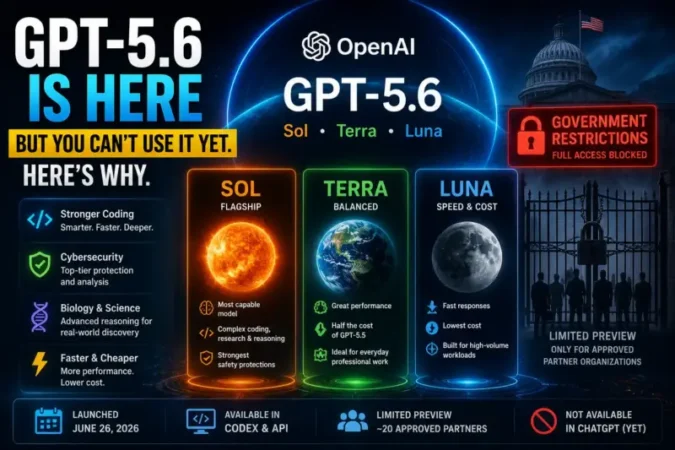
On June 26, 2026, OpenAI launched its most capable model family to date: GPT-5.6 Sol, Terra, and Luna. Same day that the US government partially lifted restrictions on Anthropic’s Mythos 5. Same week that GPT-4.5 was permanently retired. And yet, despite the launch, the vast majority of ChatGPT users and API developers woke up the next morning with no access to any of it.
Here is the honest, fully sourced breakdown of what GPT-5.6 actually is, why you probably can’t use it yet, and what it means for the rapidly shifting landscape of frontier AI.
Three Models, One Family – What Each Does
OpenAI launched GPT-5.6 as a three-tier family rather than a single flagship, a structure that mirrors how they’ve organized previous generations.
GPT-5.6 Sol is the flagship – OpenAI’s most capable model to date, positioned for complex coding, cybersecurity research, biology workflows, and long-horizon reasoning. Sol stands for the highest end of the capability spectrum, with the strongest safety protections applied accordingly.
GPT-5.6 Terra sits in the middle – a balanced model for everyday professional work. According to OpenAI’s official announcement, Terra delivers competitive performance to GPT-5.5 at roughly half the cost. For teams that don’t need Sol’s frontier capabilities but want a meaningful upgrade from what they’re running today, Terra is designed to be the practical choice.
GPT-5.6 Luna is the speed and cost tier – designed for high-volume workloads where response time and price per token matter more than maximum capability. Luna brings strong performance at what OpenAI describes as its “lowest cost” within the GPT-5.6 family.
All three launched simultaneously into a limited preview on June 26, available only in Codex and the API for a small number of government-approved partner organizations. ChatGPT users – even on Max and Pro plans – cannot access any of the three models as of June 29.
Why the Government Is Involved in an AI Model Launch
This is the genuinely new story underneath the product launch, and understanding it requires a bit of context.
Following the US government’s decision to restrict Anthropic’s Fable 5 and Mythos 5 on June 12 a situation we covered in depth in our full Fable 5 suspension article Washington has effectively established a new informal precedent: frontier AI models with significant cybersecurity capabilities require government review before broad public release.
OpenAI did not wait for a directive. The company spent a month previewing GPT-5.6’s capabilities with US government officials, including meetings CEO Sam Altman held with the White House in early June. When the launch date arrived, OpenAI proactively agreed to start with a limited preview restricted to approximately 20 companies whose participation was approved by the government rather than risk the kind of sudden ban that hit Anthropic two weeks earlier.
OpenAI was explicit that this is not a model it wanted. In its own launch post, the company stated: “We don’t believe this kind of government access process should become the long-term default. It keeps the best tools from users, developers, enterprises, cyber defenders, and global partners who need them. We are taking this short-term step because we believe it is the strongest path to broader availability in the coming weeks.”
The phrasing “short-term step,” “coming weeks,” “broader availability” signals confidence that the restricted window will be brief. But after watching Fable 5 remain offline for sixteen days and counting, that confidence is not a guarantee.
What GPT-5.6 Sol Actually Does Better
The performance claims in OpenAI’s announcement are specific enough to evaluate, and they hold up to scrutiny across three key domains.
Cybersecurity: Sol is described as OpenAI’s most capable model yet for security tasks. On ExploitBench, it performs competitively with Anthropic’s Mythos Preview the specialized cybersecurity model at the center of the government restrictions while using approximately one-third of the output tokens. On ExploitGym, a benchmark developed by UC Berkeley researchers in collaboration with OpenAI and other frontier labs, all three GPT-5.6 models show strong improvements in cyber capabilities as reasoning effort increases.
OpenAI is careful to note that Sol does not cross what it calls the “Cyber Critical” threshold under its Preparedness Framework. In evaluations involving Chromium and Firefox, it identified bugs and exploitation primitives but “did not autonomously produce a functional full-chain exploit under the conditions tested.” This is the same category of nuance that defined the dispute around Fable 5 and exactly why the government wanted to review it before broad release.
Biology: On GeneBench v1 a benchmark evaluating long-horizon genomics and quantitative biology analyses Sol outperforms GPT-5.5 while using fewer tokens. This is a newer area of frontier model capability that was barely discussed a year ago and is now explicitly a priority in both OpenAI’s and Anthropic’s development roadmaps.
Terminal and CLI work: Sol sets a new state-of-the-art on Terminal-Bench 2.1 for scientific computing in terminal environments. Given that developer tooling costs are an increasingly important factor in AI adoption decisions, performance improvements on terminal benchmarks translate directly to real-world value for engineering teams.
The Retirement Happening Alongside the Launch
The GPT-5.6 launch coincided with two significant retirements that existing ChatGPT users need to know about.
GPT-4.5 was permanently retired from ChatGPT on June 26, 2026. This applies to all ChatGPT plans and custom GPTs. This retirement had been announced on May 28 and applies to ChatGPT only the model remains available in the API.
GPT-5.2 models (Instant, Thinking, and Pro) were retired on June 12, 2026. Existing conversations that used GPT-5.2 are automatically continuing on the corresponding GPT-5.5 model. OpenAI’s general policy is that models remain available in ChatGPT for 90 days after a successor is released; GPT-5.2’s shorter window reflected a 30-day sunset applied to that generation.
Additionally, OpenAI o3 is scheduled for retirement from ChatGPT on August 26, 2026 also following a 90-day sunset period.
Pricing: What We Know and What We Don’t
OpenAI has not published full public pricing for GPT-5.6 Sol, Terra, and Luna as of this writing. What is confirmed from the announcement is directional: Terra is explicitly positioned at half the cost of GPT-5.5 for competitive performance, and Luna is designed as the lowest-cost option in the family.
For context, GPT-5.5 currently runs at $5 per million input tokens and $30 per million output tokens via the API. If Terra genuinely delivers near-GPT-5.5 performance at half the price approximately $2.50 input and $15 output per million tokens it would sit squarely between Gemini 3.1 Pro ($2/$12) and the current Claude Sonnet tier in the market.
GPT-5.6 Sol’s pricing has not been announced. Based on the pattern of previous flagship releases and the model’s positioning against Mythos Preview, it would be reasonable to expect pricing at or above GPT-5.5’s current rates. Any specific figure before an official announcement would be speculation.
What This Means for Developers Right Now
The practical situation as of June 29 is that GPT-5.6 is not available to most developers, regardless of their existing API tier or ChatGPT plan. The approximately 20 approved partner companies have access through Codex and the API. Everyone else is waiting.
OpenAI says broader availability is coming “in the coming weeks” and that the US government is aware of and has expressed support for those plans, with no anticipated severe restrictions beyond the current limited preview period. The company notably did not expect to have to limit access to 20 partners at launch Axios reported that OpenAI had anticipated a “staggered release” but not restrictions this tight.
For teams making tooling decisions right now, the landscape looks like this: GPT-5.5 remains the most capable OpenAI model you can actually access today. Claude Opus 4.8 remains available and leads on some coding and knowledge-work benchmarks as we detailed in our model comparison. GLM-5.2 remains the strongest open-weight option for cost-sensitive work. None of the restricted frontier models Fable 5, Mythos 5, GPT-5.6 Sol are accessible to general users.
The Bigger Pattern Nobody Is Talking About Enough
Step back from the product specs for a moment, and a more significant shift comes into focus. Two weeks ago, the US government banned the most capable Anthropic model mid-deployment, globally, with 90 minutes notice. This week, OpenAI proactively staged its most capable model launch behind government review not because it was forced to, but because it wanted to avoid Anthropic’s outcome.
This is the new normal for frontier AI, and it did not exist six months ago. The most capable AI systems are now subject to something resembling a government review process before they can be widely released.
Single-model dependency is now a real operational risk. A model you depend on today can be made inaccessible tomorrow, not because of a technical failure or business decision, but because of a government directive. OpenAI made clear it sees this as a temporary situation and will push for broader access quickly but “quickly” is not a timeline you can put in a production architecture document.
Frequently Asked Questions
When can I use GPT-5.6 Sol, Terra, or Luna? Not yet, unless you are one of approximately 20 government-approved partner organizations. OpenAI says general availability is coming “in the coming weeks,” with the government’s support. No specific date has been announced.
Is GPT-5.6 Sol better than Claude Opus 4.8? On cybersecurity benchmarks and Terminal-Bench 2.1, Sol appears to lead or match Opus 4.8. On knowledge work and some coding benchmarks, Opus 4.8 has held strong in independent evaluations. A complete head-to-head comparison will be possible once Sol is publicly accessible and independently benchmarked.
Why is GPT-4.5 being retired? OpenAI retires older models approximately 90 days after a successor is released. GPT-4.5 hit its sunset window on June 26. It remains available in the API for developers but has been removed from ChatGPT across all plans including custom GPTs.
Is Terra really 2x cheaper than GPT-5.5? That is OpenAI’s stated positioning “competitive performance to GPT-5.5 while being 2x cheaper.” Official API pricing has not been published at the time of this writing. Once pricing is confirmed publicly, we’ll update this article.
Does this affect India or international users differently? The GPT-5.6 restrictions apply to everyone outside the approved partner list, regardless of country. International users are not uniquely disadvantaged relative to US users who aren’t on the approved list both are waiting for general availability. When Sol and the other models do open broadly, they are expected to be globally accessible, unlike the nationality-gated Fable 5 situation.
This article is based on OpenAI’s official June 26 announcement at openai.com/index/previewing-gpt-5-6-sol/, OpenAI’s model release notes at help.openai.com, Axios’s reporting on the government review process, and Thurrott’s coverage of the limited preview. Pricing and access details will be updated as OpenAI publishes them. Last updated June 29, 2026.