
The AI job market 2026 data tells a more interesting story than either the hype or the panic suggests. Open any careers page right now and you will see the same word stamped on half the listings: AI. But here is the uncomfortable question nobody asks out loud does adding “AI skills” to your resume actually move the needle, or is it just noise in a market everyone claims to understand and almost nobody actually does?
The honest answer, based on the data that has come out so far in 2026, is more interesting than either the hype or the panic. AI is not simply creating jobs or destroying them. It is splitting the labor market into two very different tracks and which track you end up on depends on specific, identifiable choices you can still make.
The AI Job Market 2026 Headline Number: Postings Grew 163% in a Single Year
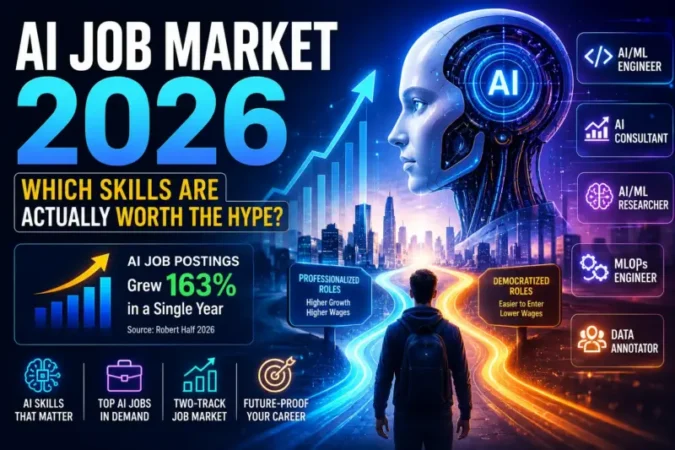
Start with the scale, because it explains why this conversation feels so loud right now. AI, machine learning, and data science job postings totaled 49,200 in 2025, up 163% from the year before, according to Robert Half’s 2026 hiring research. That is not a niche trend confined to Silicon Valley security roles grew 124% over the same period, and together these two categories are reshaping what “tech hiring” even means in 2026.
LinkedIn’s own internal data tells a similar story from a different angle. According to the World Economic Forum’s coverage of LinkedIn’s research, AI has already added 1.3 million new jobs globally, including newly created roles like Forward-Deployed Engineers and Data Annotators that barely existed three years ago. And in LinkedIn’s 2026 Jobs on the Rise report, AI Engineer ranked as the single fastest-growing job title in the United States, with postings up 143% year-over-year.
If you are wondering whether this is just a temporary spike, the Stanford HAI 2026 AI Index offers a longer view: AI-related skills now appear in 2.5% of all US job postings, a 297% increase over the past decade, growing roughly 20 times faster than the overall job market.
The Part Most Career Advice Skips: It’s a Two-Track Market
Here is where the story gets genuinely useful instead of just impressive. PwC’s 2026 Global AI Jobs Barometer, which analyzed more than one billion job advertisements across six continents, found that AI is creating what researchers call a “two-track” labor market and understanding which track you are on matters more than simply having “AI skills” on your resume.
On one track, AI is “professionalizing” certain roles automating the routine parts of the job so that what remains requires more human judgment, not less. Think radiologists or senior recruiters. On the other track, AI is “democratizing” roles, making them easier for less experienced people to perform adequately. Think entry-level IT support or basic content drafting.
The data on what happens to each track is striking. Professionalized roles are growing twice as fast as democratized ones, with 42% faster wage growth since 2021. If your role is becoming more dependent on the judgment calls AI still cannot make, you are likely on the winning side of this split. If AI is making your core task something anyone can do with the right prompt, the wage and growth trajectory looks very different.
This matters directly if you are trying to understand how AI content tools are reshaping work more broadly the same dynamic of “judgment versus execution” shows up in how Google evaluates AI-assisted content, not just in hiring data.
The Five Roles Actually Driving Demand Right Now
Rather than a vague “AI skills are good” message, here is what’s concretely growing, based on LinkedIn’s 2026 report and supporting research from HeroHunt’s AI roles analysis.
AI / Machine Learning Engineers top the list as the single fastest-growing job title in the US, with the most common required skills being LangChain, retrieval-augmented generation (RAG), and PyTorch. Notably, the median prior experience for people hired into this role is just 3.7 years this is not exclusively a senior-level field anymore.
AI Consultants and Strategists are rising fast as companies realize that buying AI tools and actually deploying them productively are two very different skill sets. This role sits closer to business strategy than pure engineering.
AI/ML Researchers focus on designing and testing new models, with deep learning, PyTorch, and computer vision as the most common skill combination concentrated heavily in technology, higher education, and research institutions.
MLOps Engineers have moved from a nice-to-have to a baseline requirement. According to Dice’s coverage of the LinkedIn report, model versioning, monitoring, cost optimization, and governance skills are now treated as minimum requirements rather than differentiators for AI-related roles.
Data Annotators round out the list an understated but fast-growing role, since the labeled data pipelines underpinning model quality require this function to scale alongside everything else.
Prompt Engineering: Smaller Than the Headlines Suggested, But Real
If you have heard “prompt engineer” thrown around as the defining job title of the AI era, the actual 2026 data tells a more grounded story one we cover in more depth in our dedicated prompt engineering career guide. Prompt engineering increasingly functions less as a standalone job title and more as a foundational skill layered onto other roles closer to how “Excel proficiency” became assumed knowledge rather than a job title in itself.
That said, demand for the skill specifically is still climbing. Research from Futurense’s 2026 AI skills analysis found prompt engineering demand growing steadily as generative AI use cases expand across industries, describing it as “perhaps the most democratized AI skill” one nearly every knowledge worker is now expected to develop to some degree, even if it is not their core job title.
The Wage Premium Is Real, and It’s Growing Fast
This is the number worth sitting with: PwC’s analysis found that workers with advanced AI skills earn 56% more than peers in the same roles without those skills up sharply from a 25% premium just one year earlier, according to HeroHunt’s compiled 2026 rankings. For professionals who combine multiple AI competencies, the premium climbs to a reported 43% above peers with no AI skills at all in some analyses.
This is not a gradual trend playing out over a decade. It is, in the words of HeroHunt’s research summary, “a market repricing in real time.”
What This Means If You’re Early in Your Career
The traditional career ladder is compressing in a way that genuinely changes the early-career calculus. PwC’s research found that the most AI-exposed junior roles are seven times more likely than the least AI-exposed junior roles to demand traditionally senior skills like leadership and strategic thinking. At the same time, “seniorized” entry-level roles junior positions that now expect senior-level judgment have grown 35% since 2019, even as routine entry-level postings in highly AI-exposed sectors have flatlined.
There’s a credentials shift worth knowing about too. According to Gloat’s 2026 workforce research, the percentage of AI-augmented jobs requiring a formal degree fell from 66% in 2019 to 59% in 2024, with McKinsey research showing that employees hired based on demonstrated skills are 30% more productive in their first six months than those hired primarily on degree credentials.
The practical translation: if you’re early-career, the fastest path in isn’t necessarily a credential it’s a portfolio of demonstrated, applied work. This is also why hands-on experimentation with AI coding tools and real model comparisons matters more in 2026 than it did even two years ago employers are increasingly evaluating what you’ve actually built, not just what you’ve studied.
A Necessary Reality Check
Not every signal in 2026’s labor data points in the same optimistic direction, and a genuinely useful guide should say so. Goldman Sachs Research projects that roughly 6 to 7% of workers could be displaced during the broader AI adoption transition, with entry-level workers in knowledge and content creation sectors flagged as most exposed. LinkedIn’s own data shows hiring in advanced economies running 20 to 35% below pre-pandemic levels though notably, the same research found this slowdown is driven primarily by economic uncertainty and monetary policy, not AI itself, since hiring patterns look similar across high-AI-exposure and low-AI-exposure jobs outside of a few specific sectors like clinical healthcare.
The honest picture, then, is not “AI is taking jobs” or “AI is only creating jobs” both oversimplify a market that is genuinely splitting in two different directions at once, with real winners and real disruption happening simultaneously.
How to Actually Position Yourself in This Market
Based on everything the 2026 data shows, a few concrete moves stand out as genuinely useful rather than generic advice.
Build toward the “professionalized” side of your field rather than the “democratized” side meaning, look for ways AI can remove the routine parts of your work so what remains requires more judgment, not less.
Treat hands-on deployment experience as more valuable than theoretical knowledge. The data consistently shows employers prioritizing people who have actually shipped something using AI tools over those who can only describe how the tools work.
If you’re early-career, don’t wait for a senior title to start demonstrating senior-level judgment the data shows entry-level roles increasingly expect this earlier than they used to.
Don’t treat prompt engineering as a destination job title. Treat it as a baseline literacy layered onto whatever your actual specialization becomes engineering, consulting, research, or operations.
The Bottom Line
The AI job market in 2026 rewards specificity over vague enthusiasm. “I know how to use AI” is no longer a differentiator when over 90% of organizations are budgeting for AI tools and upskilling. What separates the 56% wage premium from the rest is demonstrated, applied capability in a role where AI has raised the ceiling for what good judgment looks like not just familiarity with the tools themselves.
The market is moving fast enough that the skills considered cutting-edge in early 2026 may be baseline expectations by 2027. The professionals thriving in this environment aren’t the ones who learned the most tools they’re the ones who got specific about where their judgment adds value that AI still can’t replicate.
Frequently Asked Questions
How much do AI skills actually increase salary in 2026? According to PwC’s 2026 analysis, workers with advanced AI skills earn approximately 56% more than peers in equivalent roles without those skills, up from a 25% premium the year before. Professionals combining multiple AI competencies see an even larger gap in some studies.
What is the fastest-growing AI job in 2026? AI Engineer (also called Machine Learning Engineer) ranked as the single fastest-growing job title in the United States in LinkedIn’s 2026 Jobs on the Rise report, with postings up 143% year-over-year and a median of just 3.7 years of prior experience among new hires.
Is prompt engineering still a real job in 2026? Demand for prompt engineering skills continues to grow, but it increasingly functions as a skill layered onto other roles rather than a standalone job title for most professionals. It remains one of the most accessible AI skills for any knowledge worker to develop.
Will AI replace more jobs than it creates in 2026? The data shows a mixed picture rather than a single answer. LinkedIn and PwC data point to significant job creation (1.3 million new roles globally), while Goldman Sachs Research projects 6-7% of workers could face displacement during the broader multi-year transition. Both trends are occurring simultaneously in different parts of the labor market.
Do I need a degree to get an AI job in 2026? Formal degree requirements for AI-augmented roles have been declining, dropping from 66% in 2019 to 59% in 2024 according to PwC data cited by Gloat. Many employers are prioritizing demonstrated, applied skills and portfolio work over credentials alone.
This article is based on research from LinkedIn’s 2026 Jobs on the Rise report, PwC’s 2026 Global AI Jobs Barometer, Robert Half’s 2026 hiring research, the World Economic Forum, Goldman Sachs Research, and Stanford HAI’s 2026 AI Index, current as of June 2026. Labor market data evolves quickly figures cited reflect the most recent published research available at time of writing.