
What you’ll learn: How much prompt engineers actually earn in 2026 across experience levels and countries, which skills command the highest salaries, whether the career is sustainable long-term, and exactly how to get started all backed by verified data from LinkedIn, Glassdoor, and industry reports.
What Is a Prompt Engineer and Why Does the Role Pay So Well?
Prompt engineer salary figures in 2026 have surprised a lot of people and for good reason. This is a role that barely existed three years ago, yet it now commands compensation packages that rival senior software engineers at established tech companies.
But before understanding the pay, it helps to understand what the role actually involves. A prompt engineer is a professional who designs, tests, and optimises the instructions called prompts that guide AI language models to produce accurate, useful, and consistent outputs. The difference between a poorly written prompt and a well-engineered one can mean the difference between an AI tool that helps a business and one that wastes everyone’s time.
That gap in output quality is precisely why companies pay well for this skill. A skilled prompt engineer can improve AI output quality dramatically, reduce costly errors in automated workflows, and compress what would take a team of writers or analysts days into a process that runs in hours. The return on investment is measurable and direct which is what makes competitive salaries defensible.
Prompt Engineer Salary 2026: Global Figures by Experience Level
Salary ranges for prompt engineers vary significantly depending on experience level, location, company type, and whether the role is focused on technical development or content and strategy. The figures below are drawn from Glassdoor’s 2025 AI Roles Salary Report, LinkedIn Salary Insights, and Levels.fyi’s AI compensation data.
Entry-Level Prompt Engineers (0–2 Years Experience)
Entry-level roles in 2026 typically fall between $60,000 and $90,000 per year in the United States. These positions are usually found at mid-sized companies integrating AI into their content, customer support, or operations teams. At this stage, the role involves executing prompt strategies designed by senior engineers, testing outputs, and documenting what works.
The lower end of this range reflects roles with minimal technical requirements primarily content-adjacent positions at marketing agencies or SaaS companies. The upper end reflects roles at AI-native startups where even junior engineers are expected to work directly with model APIs.
Mid-Level Prompt Engineers (2–5 Years Experience)
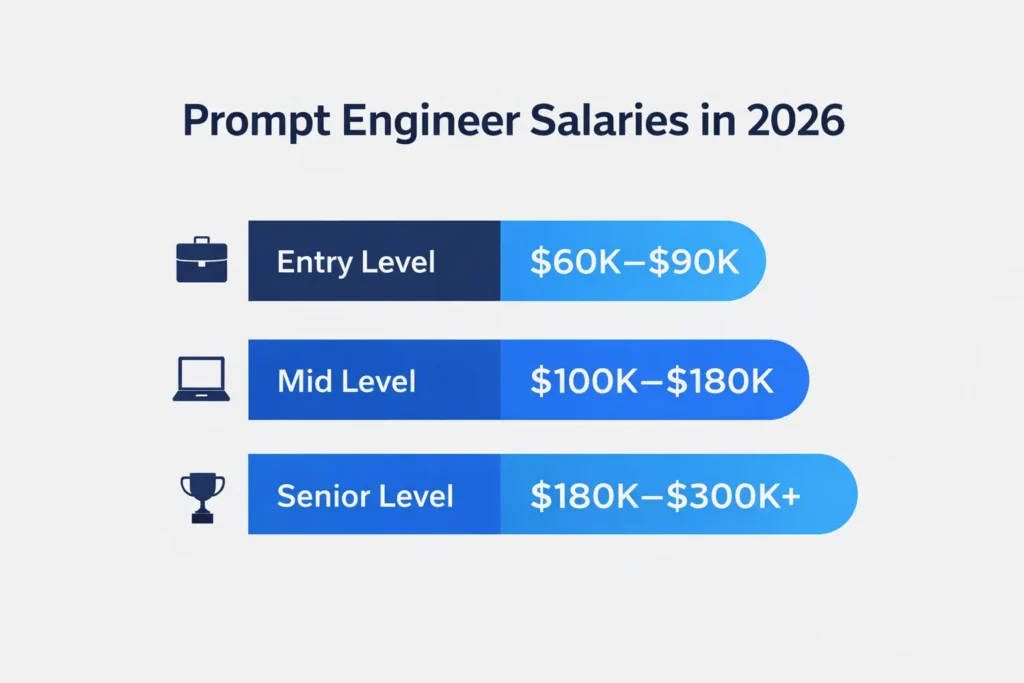
Mid-level salaries range from $100,000 to $180,000 per year in the US market. At this stage, professionals are expected to own entire prompt systems, not just individual prompts. They design multi-step workflows, integrate AI outputs into existing software systems, and often work directly with product and engineering teams to define how AI models are used across a product.
The $180,000 figure at the top of this band typically reflects roles at companies like Anthropic, OpenAI, or Google DeepMind where prompt engineering intersects with model research and product development at a high level.
Senior Prompt Engineers (5+ Years Experience)
Senior roles and team lead positions in 2026 command $180,000 to $300,000 per year, with total compensation packages at top-tier AI companies reaching $350,000 or more when stock and bonuses are included. According to Levels.fyi’s 2025 AI compensation tracker, senior AI roles at companies like OpenAI and Anthropic consistently land in this band when equity is factored in.
At this level, the role is less about writing prompts and more about architecting AI systems, leading cross-functional teams, and setting the strategic direction for how an organisation uses generative AI.
Prompt Engineer Salary in India (2026)
India’s AI job market has grown substantially in the past two years, driven by the expansion of global tech companies into Indian development hubs and the rapid growth of domestic AI startups. According to AmbitionBox’s 2025 India Tech Salaries Report and Naukri.com’s AI Jobs Salary Trends:
Entry-level (0–2 years): ₹6 LPA to ₹12 LPA
Mid-level (2–5 years): ₹12 LPA to ₹30 LPA
Senior-level (5+ years): ₹30 LPA to ₹80 LPA and above
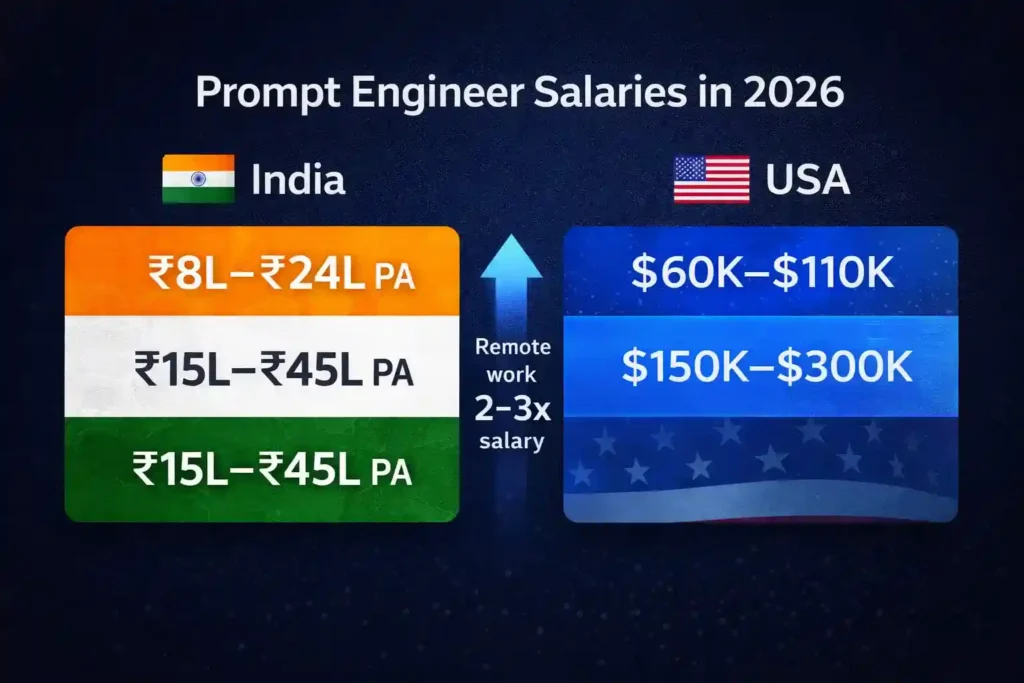
The most significant salary jump for Indian-based prompt engineers comes from working remotely for US or European companies. Remote roles with international employers typically pay two to three times the equivalent local salary for the same level of experience, because companies are paying for the skill rather than the local market rate.
This gap makes remote work strategy an important part of career planning for prompt engineers based in India. Building a strong English-language portfolio, developing skills in technical prompt workflows, and targeting companies that have established remote-first hiring policies are the most reliable paths to accessing international salary bands from India.
What Does a Prompt Engineer Actually Do Day to Day?
The job title sounds abstract, but the day-to-day work is concrete and measurable. Here is what the role looks like in practice across different company types.

At a Content or Marketing Company
A prompt engineer working in a content-focused role spends most of their time developing prompt systems for blog production, social media, email marketing, and SEO content. They test different prompt structures across multiple AI models, document which approaches produce consistent output quality, and train other team members on how to use the systems they build. They also monitor output quality over time as underlying AI models are updated because a prompt strategy that works perfectly on one model version may degrade when the model is updated.
At a SaaS or Tech Company
In a product context, a prompt engineer works closely with software developers to integrate AI outputs into the product experience. This might mean engineering the prompts that power a chatbot, designing the instructions that feed an AI summarisation feature, or building the prompt chains that drive an automated research tool. Here the role has a stronger technical dimension working with APIs, understanding token limits and cost efficiency, and testing prompts programmatically across hundreds of edge cases.
At an Enterprise or Consulting Firm
At large enterprises, prompt engineers often play an internal consulting role helping different departments understand how to apply AI tools to their specific workflows. This is more of a training and systems design role. The prompt engineer is the person who translates general-purpose AI capabilities into specific, reliable solutions for legal teams, HR departments, finance operations, and customer service functions.
Skills That Directly Impact Prompt Engineer Salary
Not all prompt engineers earn the same salary, even at the same experience level. The skills that most reliably push compensation higher are the ones that bring measurable business value not just technical fluency.
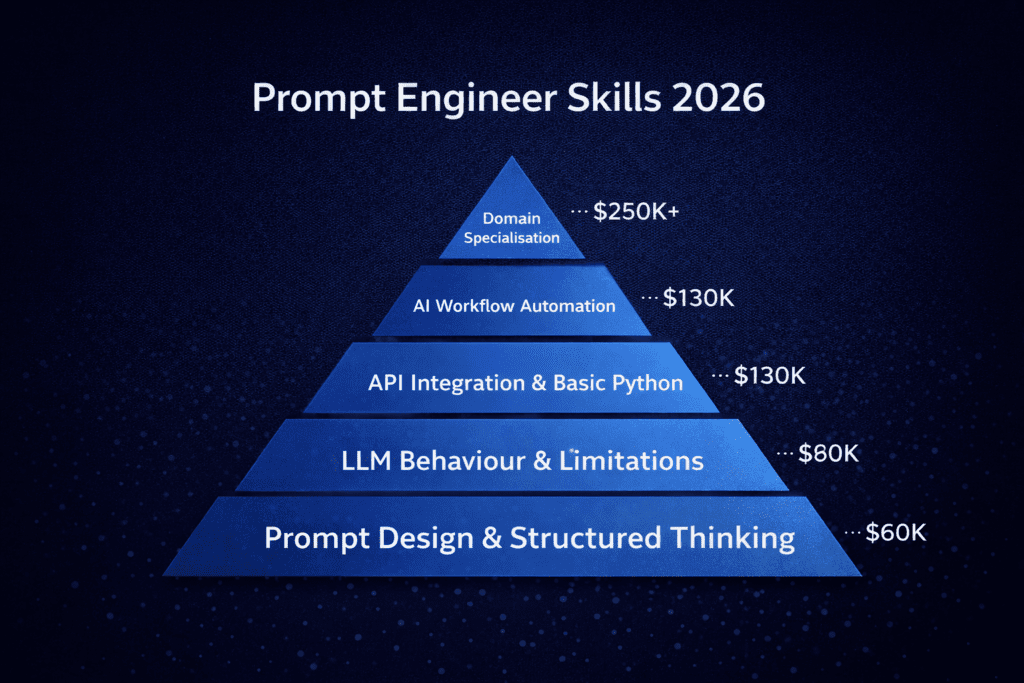
Prompt Design and Structured Thinking
The foundational skill. Understanding how to structure a prompt for clarity, specificity, and reproducibility is what separates prompt engineers from people who just type questions into ChatGPT. This involves understanding how different AI models respond to instruction framing, role assignment, chain-of-thought prompting, few-shot examples, and output formatting constraints.
Understanding of LLM Behaviour and Limitations
Knowing how large language models work not at a deep machine learning level, but at the level of understanding token limits, context windows, hallucination patterns, and how different training approaches affect model behaviour is a skill that commands a premium. Prompt engineers who understand why a model produces a certain output are far more valuable than those who can only observe what it produces.
API Integration and Basic Programming
According to LinkedIn’s 2025 Emerging Jobs Report, prompt engineering roles that require even basic Python knowledge command salaries 20–35% higher than purely non-technical equivalents. The ability to build prompt workflows programmatically calling APIs, parsing outputs, chaining multiple model calls, and logging results turns a content skill into a systems skill, which is significantly more valuable.
AI Workflow Automation
The fastest-growing sub-skill in prompt engineering right now is the ability to build automated workflows using tools like Make, n8n, LangChain, and similar platforms. A prompt engineer who can wire together an AI workflow that ingests a client brief, generates multiple content drafts, scores them against a rubric, and delivers the best option to a content management system is providing enormous operational value. That level of automation skill pushes salaries toward the upper end of each experience band.
Domain Specialisation
Prompt engineers who specialise in a high-value domain legal, medical, financial services, or e-commerce consistently earn more than generalists. Domain specialisation means understanding the specific constraints, terminology, and quality standards of an industry, and being able to engineer prompts that produce output meeting those standards reliably. A prompt engineer who understands healthcare documentation standards and can build AI workflows for clinical note generation is a very different hire from a general content prompt engineer.
Job Outlook: Is Prompt Engineering a Sustainable Career?
This is the question most people researching the field genuinely want answered. And the honest answer is: yes, with an important caveat.
The Demand Is Real and Growing
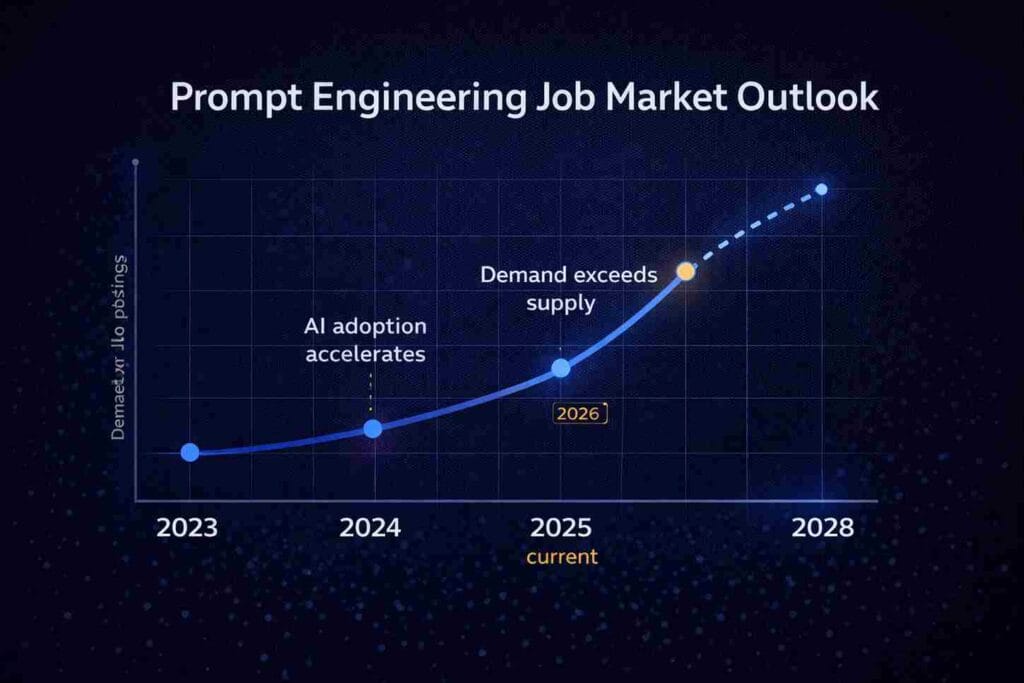
McKinsey’s 2025 State of AI Report found that 72% of organisations had adopted AI in at least one business function by the end of 2024 up from 55% the year before. Every one of those organisations needs people who can make their AI tools work reliably. That is a massive and still-expanding talent gap.
Indeed’s 2025 Job Trends Report noted that listings for AI-related roles including prompt engineering, AI content strategy, and LLM operations grew significantly year over year. The supply of qualified candidates has not kept pace with demand, which is one of the primary drivers of the salary levels discussed above.
The Role Is Evolving – Not Disappearing
The caveat worth understanding: the specific tasks within prompt engineering are changing fast. AI models are getting better at interpreting less-structured instructions, which means the manual effort of carefully engineering every word of a prompt is becoming less necessary for routine tasks. Basic prompt writing is being commoditised.
What is not being commoditised is the higher-order skill set: understanding AI system design, building reliable automation workflows, managing AI output quality at scale, and knowing how to integrate AI capabilities into complex business processes. The prompt engineers who will continue to command high salaries in 2027 and beyond are the ones who are building those deeper skills now.
Think of it like web development in the early 2010s. Basic HTML and CSS skills became widespread quickly, which pushed compensation for pure HTML coders downward. But the developers who learned JavaScript, backend frameworks, and system architecture saw their salaries keep rising. The same pattern is unfolding in prompt engineering.
Types of Prompt Engineering Roles in 2026
The job market for prompt engineers has matured enough that distinct role types have emerged, each with different skill requirements and salary profiles.
Content and SEO Prompt Engineer
This role focuses on using AI to produce, optimise, and scale content for marketing purposes. It sits at the intersection of SEO strategy and AI tool proficiency. Typical responsibilities include building prompt systems for blog content, developing quality evaluation frameworks for AI-generated text, and managing the human review processes that ensure published content meets editorial standards. Salaries for this role type fall in the lower-to-mid range of the overall band, reflecting the content-adjacent nature of the work.
AI Automation Specialist
This role focuses on building end-to-end automated workflows that use AI as a processing layer. Email automation, lead qualification, report generation, and customer support triage are common applications. This role type commands higher salaries than content-focused roles because of the technical complexity involved and the direct operational cost savings it delivers.
Developer-Focused Prompt Engineer
At the technical end of the spectrum, developer-focused prompt engineers work directly with model APIs, build LLM-powered applications, and operate in engineering team contexts. This role requires programming skills, familiarity with software development processes, and often a computer science or related technical background. It commands the highest salaries within the prompt engineering category.
Enterprise AI Consultant
A newer role type emerging in 2025 and growing in 2026. Enterprise AI consultants work with large organisations to identify AI implementation opportunities, design prompt systems and workflows for specific business functions, train internal teams, and measure the business impact of AI adoption. This role requires both technical AI knowledge and strong communication and business analysis skills.
How to Start a Career in Prompt Engineering in 2026
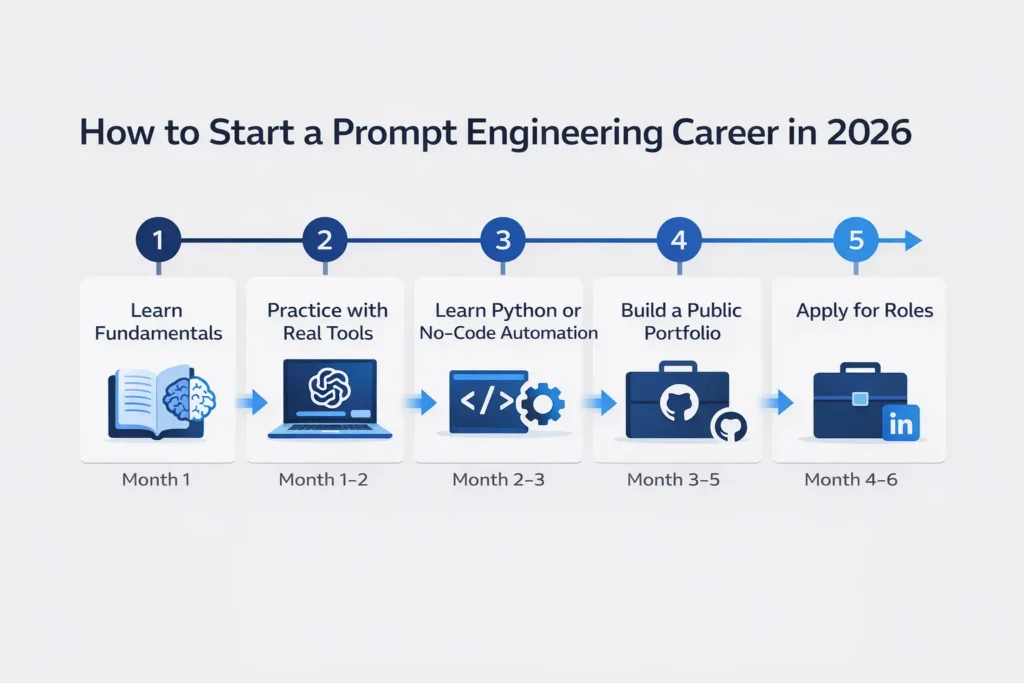
The most common mistake people make when trying to enter this field is focusing on tool familiarity rather than skill development. Using ChatGPT every day does not make someone a prompt engineer, just as using Microsoft Word every day does not make someone a technical writer.
Build Foundational Knowledge First
Start with a structured understanding of how large language models work. You do not need a machine learning degree, but you do need to understand concepts like context windows, temperature settings, system prompts versus user prompts, and how different model architectures affect output behaviour. Anthropic’s documentation, OpenAI’s prompt engineering guide, and DeepLearning.AI’s short courses are all genuinely useful starting points.
Practice With Real Problems, Not Toy Examples
The difference between a portfolio that gets ignored and one that gets interviews is specificity. Instead of showing that you can make ChatGPT write a poem, show that you built a prompt system that produces consistent product descriptions for an e-commerce store, or that you designed a prompt workflow that reduced a client’s content production time significantly. Real problems with measurable outcomes are what hiring managers look for.
Learn Basic Python or No-Code Automation
Even a basic ability to call an API and parse a JSON response will differentiate you from the majority of candidates who interact with AI only through chat interfaces. Python.org’s beginner tutorials or platforms like Replit make this accessible without any prior programming experience. If code feels like too large a step, start with no-code automation tools like Make or Zapier to build AI workflows without writing code.
Build a Public Portfolio
A GitHub repository of prompt libraries, a blog documenting your experiments, or a case study showing a real problem you solved with AI are all effective portfolio formats. The goal is to give potential employers or clients evidence that you can think systematically about prompt design, not just that you know what the term means.
Target Your Job Search Strategically
For full-time roles, LinkedIn, Wellfound (formerly AngelList), and AI-specific job boards like PromptEngineerJobs.com are the most productive channels in 2026. For freelance work, Upwork and Toptal both have growing demand for AI workflow and prompt engineering specialists. Remote roles with international companies are the fastest path to accessing the higher end of the global salary ranges from anywhere in the world.
Frequently Asked Questions
What is the average prompt engineer salary in 2026?
In the United States, prompt engineer salaries in 2026 range from $60,000 per year at entry level to over $300,000 for senior roles at top AI companies. The mid-level range of $100,000 to $180,000 represents the most common compensation band for professionals with two to five years of experience. Salaries vary significantly by company type, location, and whether the role is technical or content-focused.
Do I need a computer science degree to become a prompt engineer?
No. While a technical background helps for developer-focused roles, many prompt engineering positions particularly in content, marketing, and business automation do not require a computer science degree. What matters more is demonstrated ability to design effective prompt systems, understand AI model behaviour, and produce measurable results. A strong portfolio of real projects carries more weight than formal credentials in most hiring processes for this role.
Is prompt engineering a good career long-term?
Yes, with the understanding that the role will continue to evolve. The lower-skill aspects of prompt writing are being automated, but the higher-order skills AI workflow design, system integration, output quality management, and domain-specific AI application are growing in demand. Prompt engineers who invest in these deeper skills are well-positioned for long-term career growth.
How long does it take to become a prompt engineer?
Most people can develop foundational prompt engineering skills in two to three months of focused practice. Building a portfolio strong enough to land a first role typically takes four to six months. Moving into mid-level positions with competitive salaries generally requires one to two years of documented experience with real projects and measurable outcomes.
How much do prompt engineers earn in India?
In India, prompt engineer salaries in 2026 range from ₹6 LPA at entry level to ₹80 LPA or more at senior levels. The most significant salary increases come from working remotely for international companies, which typically pay two to three times the equivalent local market rate for the same skills. Building skills in technical prompt engineering and AI workflow automation rather than purely content-focused prompting is the fastest path to accessing international salary levels from India.
What is the difference between a prompt engineer and an AI engineer?
A prompt engineer focuses specifically on designing and optimising the instructions that guide AI model outputs. An AI engineer has a broader technical scope that typically includes model selection, fine-tuning, deployment, and infrastructure management. The roles overlap many senior prompt engineers develop AI engineering skills over time but the entry requirements differ. AI engineering generally requires stronger programming and machine learning foundations, while prompt engineering is more accessible to professionals from non-technical backgrounds.
Which industries hire the most prompt engineers?
Technology companies and AI startups are the largest employers of prompt engineers in 2026, but significant demand also exists in financial services, healthcare, legal, e-commerce, and marketing. Any industry that is adopting AI at scale needs people who can make AI tools work reliably for their specific use cases. Healthcare and financial services tend to offer the highest salaries for domain-specialist prompt engineers because of the compliance and accuracy requirements in those industries.
Can I freelance as a prompt engineer?
Yes, and freelancing is a particularly viable path in this field. Many companies need prompt engineering on a project basis to build a specific workflow, audit an existing AI system, or train a team – rather than as a permanent hire. Platforms like Upwork, Toptal, and specialist AI freelance networks all have growing demand for this skill set. Experienced freelance prompt engineers with strong portfolios are charging $75 to $200 per hour for project-based work in 2026, according to Upwork’s 2025 Skills Index.
Conclusion: The Window Is Wide Open – But Won’t Stay That Way
Prompt engineer salary levels in 2026 reflect a genuine market imbalance: companies need these skills urgently, and the supply of qualified professionals has not caught up with demand. That gap is what makes this one of the most accessible high-income career transitions available right now for people without traditional technical backgrounds.
The opportunity is real. But the window for easy entry is narrowing as the field matures and more people develop these skills. The professionals who will still be commanding premium salaries in 2028 are the ones building the deeper, harder-to-automate skills today – AI workflow design, domain specialisation, technical integration, and the ability to measure and demonstrate business impact.
Start with the foundational learning. Build something real. Document it publicly. The career path from there is well-established and the compensation is among the strongest available for skills that can be developed without a formal degree.
References & Sources
- Glassdoor – 2025 AI Roles Salary Report
- LinkedIn – 2025 Emerging Jobs Report
- Levels.fyi – AI Compensation Data 2025
- AmbitionBox – 2025 India Tech Salaries
- Naukri.com – AI Jobs Salary Trends India
- McKinsey – 2025 State of AI Report
- Indeed – 2025 Prompt Engineer Salary Trends
- Upwork – 2025 Skills Index
- OpenAI – Prompt Engineering Guide
- Anthropic – Claude Documentation
1 thought on “Prompt Engineer Salary and Job Outlook in 2026: Complete Career Guide”