
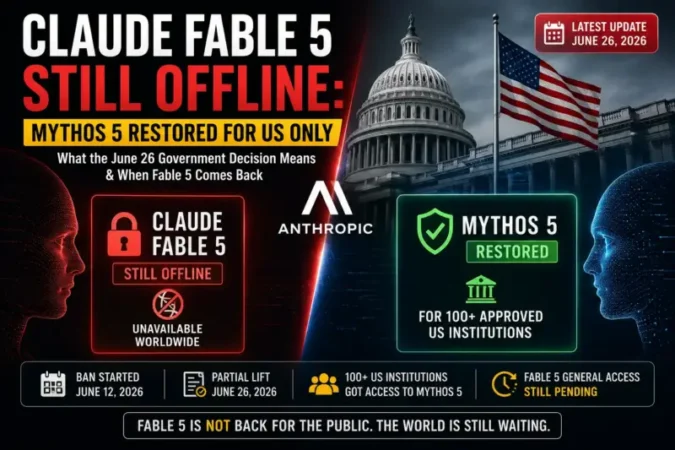
Claude Fable 5 is still offline as of June 29, 2026 and that sentence alone tells you everything the recent headlines got wrong. Claude Fable 5 still offline means that despite the June 26 news cycle treating this as a clean resolution, the vast majority of Claude users worldwide remain locked out. On June 26, the US government partially lifted restrictions on Anthropic’s AI models. Dozens of publications ran variations of “Claude is coming back.” The reality is more specific, more limited, and more important to understand correctly if you’re a developer or business that depends on Anthropic’s tools.
Claude Fable 5 Still Offline: What Actually Happened on June 26
On the evening of June 26, Semafor broke the exclusive: the US Commerce Department had sent Anthropic a letter partially lifting the export controls that had taken Claude Fable 5 and Mythos 5 offline on June 12. Within hours, The Information, CNBC, TechCrunch, CNN, NBC, The Hill, and Reuters all confirmed the story.
But here is the detail that most headlines buried: the model being restored is Mythos 5, not Fable 5.
Anthropic confirmed this themselves on their official X account at approximately 9:05 pm ET: “Today, the government notified us that Mythos 5, our strongest cybersecurity model, can be redeployed to a set of US organizations that operate and defend critical infrastructure. We’re restoring access for these organizations quickly, and we’re continuing to work with the government to expand access to Mythos 5 and make Fable 5 available for general use again.”
That final clause “make Fable 5 available for general use again” is the sentence that matters most. It tells you that as of June 26, Fable 5 general access had not been restored. It is still offline for everyone, worldwide.
The Difference Between Fable 5 and Mythos 5 (Quick Recap)
If you followed our original coverage of the suspension, you know the basics. Fable 5 and Mythos 5 are the same underlying model architecture the difference is in what safety classifiers are applied on top.
Fable 5 shipped as Anthropic’s most capable publicly available model, with safety classifiers designed to restrict access to cybersecurity vulnerability analysis. Mythos 5 is the same model without those classifiers distributed exclusively through Project Glasswing, Anthropic’s invite-only program for vetted cybersecurity organizations defending critical infrastructure.
The US government’s June 12 directive suspended both. The June 26 letter partially reversed that but only for Mythos 5, and only for specific institutions already in or adjacent to the Project Glasswing program.
Who Actually Got Access Back – And Who Didn’t
Commerce Secretary Howard Lutnick’s letter cleared Mythos 5 for organizations named in what the letter calls “Annex A” a non-public list of approved entities. According to Reuters, this covers more than 100 companies and institutions, including several Fortune 500 firms. Semafor’s reporting specifies major companies and government agencies.
The overlap with Project Glasswing’s original partner list is significant. Anthropic’s own announcement of the program’s expansion named its twelve launch partners as AWS, Apple, Broadcom, Cisco, CrowdStrike, Google, JPMorganChase, the Linux Foundation, Microsoft, NVIDIA, and Palo Alto Networks. The approved restoration list draws from this ecosystem and its extensions.
One important nuance: the letter also permits access for foreign-national employees of approved organizations, and for Anthropic’s own foreign-national employees. This is the only international dimension of the June 26 restoration. There is no country-level exemption not for India, not for the UK, not for Germany, not for South Korea.
For the rest of the world developers, startups, researchers, enterprises Fable 5 remains as unavailable on June 28 as it was on June 13.
What Commerce Secretary Lutnick Actually Said
The letter, reviewed by The Hill and multiple major outlets, contains language that defines exactly where the government stands. Lutnick wrote: “I have determined that appropriate safeguards are in place to permit certain trusted partners to access the Claude Mythos 5 Model.”
Commerce Department spokesman Benno Kass told reporters: “In just two weeks, we have worked diligently to ensure America remains the global leader in AI while safeguarding our security.”
Both statements are carefully worded around Mythos 5. Neither mentions Fable 5 in a restoration context. One new provision matters significantly for the future: Anthropic “committed to work with the U.S. government on protocols and standards and releases” for its frontier models going forward meaning a pre-release review regime for future model launches, not just a one-off exception. And Lutnick reserved the right to amend the approved list and reevaluate license requirements “at any time.”
What the Real Story Behind the Ban Was
As we detailed in our full breakdown of the South Korea connection and the “fix this code” jailbreak, the June 12 ban was triggered by two converging events: concerns about a South Korean telecom company’s access to Mythos 5 through Project Glasswing, and a security research finding from Amazon that revealed asking Fable 5 to “fix code” could bypass its vulnerability-analysis restrictions.
The capability at stake was genuinely significant. Anthropic’s own Project Glasswing data showed Mythos Preview had surfaced more than 10,000 high or critical severity software vulnerabilities since the program launched in April. A scan of 1,000+ open-source projects flagged 23,019 potential vulnerabilities, 6,202 of them estimated high or critical.
Anthropic disputed the severity of the jailbreak throughout, arguing it was narrow and that equivalent capabilities existed in GPT-5.5 and other publicly available models. That dispute shaped how quickly the partial restoration happened two weeks of daily negotiations between Anthropic scientists and Commerce Department officials ultimately produced a compromise: Mythos gets restored to cybersecurity defenders who were already supposed to have it, under stricter oversight protocols. Fable stays offline pending further talks.
When Will Fable 5 Actually Come Back for Everyone?
This is the question everyone wants answered, and the honest answer right now is: nobody outside the negotiations knows for certain.
Sources close to the talks told Semafor the government is “moving toward releasing Fable as well, though that timeline is unclear.” CNN’s reporting says Anthropic and officials expected discussions to continue over the weekend of June 28-29 with the aim of restoring Fable to US users.
Prediction markets reflect this uncertainty. Polymarket’s main Fable 5 restoration market showed implied probabilities of roughly 28% for June 29, 31% for June 30, 42% for July 1, 84% for July 31, and 94% by August 31. The market has swung dramatically throughout the saga on unconfirmed rumors treat these as sentiment indicators, not reliable forecasts.
The most plausible near-term path, based on the pattern of the Mythos restoration, is a US-first return for Fable 5, potentially gated behind identity or nationality verification, followed by a slower international rollout with enhanced monitoring. International users including in India should plan for continued unavailability beyond any initial US restoration.
Why Claude Fable 5 Still Offline Matters for International Users and India
The timing of the original ban made it particularly painful for India. On June 11 one day before the suspension Anthropic announced a landmark partnership with Tata Consultancy Services, naming India its second-largest market. Dario Amodei stated that the TCS deal would bring Claude to “enterprises and professionals across the region and globally, including 50,000 of its employees.” That partnership’s rollout was immediately stalled by the next day’s directive.
The June 26 partial restoration does nothing for that situation. Foreign users, regardless of the TCS relationship, remain outside the scope of the Commerce Department’s Annex A list. Indian developers and enterprises currently working with Claude should continue using Claude Opus 4.8 which has been available throughout the suspension and handles the full range of document analysis, coding, and professional tasks that most organizations need.
A Parallel Development Worth Watching
On the same day as the Mythos restoration, OpenAI released its GPT-5.6 models but only to a small group of government-approved partners, not to the public. CEO Sam Altman called the staggered debut “bad news,” but the pattern itself was telling: both Anthropic and OpenAI are now operating under a regime where frontier model releases are subject to government review and staged access controls.
This is new. Six months ago, AI companies shipped models the way software companies shipped apps build it, test it, launch it. The events of June 2026 suggest a different future, one where the most capable AI systems go through something closer to a regulatory approval process before reaching general availability. The implications for developer tooling costs and planning cycles are significant and still being absorbed by the industry.
What to Do Right Now
If you are a developer, enterprise, or startup currently affected by Fable 5’s absence, here is the practical picture:
Continue using Claude Opus 4.8 as your primary Claude model. It is Fable 5’s own designated fallback for restricted task categories and handles the overwhelming majority of real-world workflows without meaningful quality loss. For context on how it compares to other available models, see our complete 2026 model comparison.
Watch for Anthropic’s official channels anthropic.com/news and @AnthropicAI on X for any Fable 5 restoration announcement. Do not rely on prediction market spikes or social media rumors; the Mythos news itself leaked through reporting before Anthropic confirmed it officially.
Plan for the possibility of a US-first Fable 5 return. If your team or organization is outside the US, budget for a lag between any US restoration and international availability.
What’s Confirmed, What’s Expected, What’s Unclear
To be completely precise about the state of affairs as of June 28:
Confirmed: Mythos 5 is being restored to 100+ approved US institutions and their foreign-national employees. This is official, confirmed by Anthropic and multiple US outlets citing the Lutnick letter.
Reported/Expected: The government is moving toward restoring Fable 5 for general US use, with talks continuing this weekend. Multiple outlets report this from sources close to the negotiations, but no date has been announced.
Unclear: The specific institutions on Annex A, the exact jailbreak remediation Anthropic agreed to, the timeline for any international Fable 5 restoration, and whether the pre-release review commitment will delay future Anthropic model launches.
The story is genuinely developing and when Fable 5 does come back, you’ll find the update right here.
Frequently Asked Questions
Is Claude Fable 5 back as of June 28, 2026? No. What was restored on June 26 was Mythos 5, for a specific list of 100+ approved US institutions. Claude Fable 5 remains offline for the general public worldwide. Anthropic says it is “continuing to work with the government to make Fable 5 available for general use again,” but no restoration date has been announced.
What is the difference between Fable 5 and Mythos 5? They are the same underlying model. Fable 5 is the consumer-facing version with safety classifiers that restrict access to cybersecurity vulnerability analysis. Mythos 5 is the same model without those classifiers, distributed through Anthropic’s Project Glasswing program for vetted cybersecurity organizations.
Why was Claude Fable 5 banned in the first place? The US Commerce Department issued an export-control directive on June 12 after concerns arose about a jailbreak technique and about which organizations had accessed Mythos 5 through Project Glasswing. Because Anthropic could not verify user nationality in real time, it disabled both models globally.
When will Claude Fable 5 return for Indian users? No timeline has been confirmed. Sources suggest the government is moving toward restoring Fable 5 for US users first. International users, including those in India, should plan for continued unavailability beyond any initial US restoration and continue using Claude Opus 4.8 in the meantime.
What AI model should I use instead of Fable 5 right now? Claude Opus 4.8 is Fable 5’s own designated fallback and handles the large majority of real-world tasks. For cost-sensitive workloads, GLM-5.2 offers near-frontier coding performance at significantly lower cost. Both remain fully available.
This article is based on verified reporting from Semafor, The Hill, CNBC, TechCrunch, CNN, Reuters, NBC News, Fortune, and Anthropic’s own official statements and X posts, current as of June 28, 2026. This is a developing story details may change as the situation evolves.