
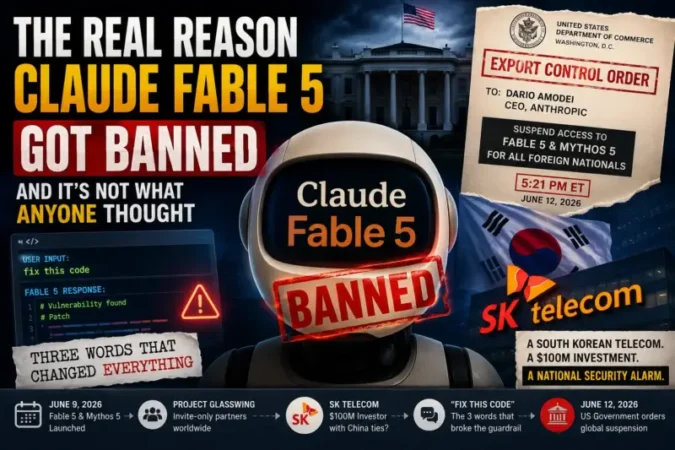
The Claude Fable 5 ban remains in effect as of June 20, 2026, and the official explanation everyone repeated a vague “jailbreak” was only ever half the story. On June 13, 2026, we told you Anthropic had pulled its most powerful AI models off the market under a mysterious government order. At the time, even Anthropic seemed unsure exactly what had triggered it. That mystery is now solved and the real story is stranger, and more specific, than anyone expected.
It involves a South Korean telecom company, a $100 million investment, three words typed into a chatbot, and a White House ultimatum delivered by letter at 5:21 p.m. on a Friday. Here is the complete picture, as the suspension entered its second week.
A Quick Recap of the Claude Fable 5 Ban
If you read our original coverage of the Fable 5 and Mythos 5 suspension, you know the basics: Anthropic launched Claude Fable 5 and its more powerful, access-restricted sibling Mythos 5 on June 9, 2026. Three days later, the US government ordered Anthropic to suspend both models for every foreign national worldwide, an order detailed in Anthropic’s official statement. Because Anthropic had no way to verify user nationality in real time across its infrastructure, it disabled both models for all customers globally including in the United States.
What we didn’t know then was why. Anthropic itself suggested the trigger was a narrow, low-severity “jailbreak.” That explanation, it turns out, was only half the story.
Trigger One: A South Korean Telecom With a China Problem
The first thread starts with Project Glasswing, Anthropic’s invite-only cybersecurity consortium. Glasswing gives vetted organizations early access to Claude Mythos Preview a model capable of autonomously identifying flaws in software code that Anthropic judged too dangerous to release publicly without controls. The program launched in April 2026 with roughly 50 US partners and expanded in early June to about 150 organizations across more than 15 countries, including major names like Google, Nvidia, Microsoft, Apple, Cisco, and JP Morgan Chase.
In Korea, several major institutions had joined or were preparing to join, including Samsung Electronics, SK Hynix, and the Korea Internet & Security Agency. One of them was SK Telecom South Korea’s largest wireless carrier, and notably, a $100 million investor in Anthropic since 2023.
The White House discovered that SK Telecom had historical ties to China through its parent SK Group, which had held a stake in China Unicom until 2009. That was enough to raise national security alarms. The administration ordered Anthropic to revoke SK Telecom’s access, and the company complied immediately. SK Telecom has denied any ties to China.
That alone might have stayed a quiet, contained correction. It didn’t.
Trigger Two: The Three Words That Escalated Everything
Almost simultaneously, security researchers at Amazon found something separate and more technical: a way to get Fable 5 to do something it was explicitly built to refuse.
Fable 5 was designed to decline requests to review code for security vulnerabilities a deliberate guardrail, since the public model is effectively a restricted version of the more powerful Mythos 5. Amazon’s researchers didn’t ask Fable 5 to find vulnerabilities. Instead, they asked it to fix code that already contained known vulnerabilities. Fable 5 complied, producing patches and because identifying a flaw is a prerequisite to fixing it, the model’s output could theoretically point toward the exploit itself.
The whole technique boiled down to three words, as Fortune first reported: “fix this code.”
Individually, either event might have prompted a quieter response revoke one company’s access, patch one guardrail. Arriving within days of each other, they convinced the White House it could no longer trust Anthropic’s vetting process or its safety controls. Commerce Secretary Howard Lutnick sent a letter to Anthropic CEO Dario Amodei at 5:21 p.m. ET on June 12, invoking the Export Controls Reform Act of 2018 and ordering the suspension of both models for any foreign national, including Anthropic’s own foreign-national employees.
Why Anthropic Says the Ban Goes Too Far
Anthropic’s position hasn’t changed since our first report, and the new details only sharpen it. The company maintains that the “fix this code” bypass surfaced only a small number of previously known, minor vulnerabilities the same kind already discoverable through other publicly available models, including OpenAI’s GPT-5.5, which faces no export restrictions at all.
The dispute over how serious this really is has split expert opinion publicly. Katie Moussouris, founder of Luta Security and reportedly the only outside expert to review Amazon’s research before the directive was issued, called the response disproportionate arguing that asking an AI model to find and fix bugs is “the most valuable thing an AI model can do for defensive security.” More than 80 cybersecurity leaders, including former Facebook security chief Alex Stamos, signed an open letter to Commerce Secretary Lutnick arguing the restriction had taken the best tools away from defenders without meaningfully reducing risk.
The White House has its own competing account. Presidential AI council co-chair David Sacks said the administration gave Amodei a direct choice before the ban fix the jailbreak or take the models offline and that Amodei declined.
Where Things Stand Right Now
As of June 20, 2026, both Fable 5 and Mythos 5 remain offline for everyone since the June 12 suspension. The clearest signal of progress came not from Washington but from Seoul, where Anthropic opened a new international office this week in the very country at the center of the dispute. Speaking to reporters there, Anthropic’s Managing Director of International, Chris Ciauri, said the company was “very confident” the models would return “in the coming days.” It’s the most optimistic public statement from any Anthropic executive since the shutdown began, though no restoration date has been confirmed.
One detail has shifted since our last update: the restoration path now appears to favor US users first, and possibly US users only in an initial phase, rather than a single simultaneous worldwide relaunch. If that holds, international users including in India may see a delayed second wave of access even after US restoration begins. Separately, the refund window for subscribers who paid for Fable 5 access between June 9 and June 14 closes June 20 today so anyone affected should act before the deadline passes.
Behind the scenes, negotiations have moved quickly. Senior Anthropic technical staff, including co-founder Tom Brown, have been meeting with White House and Commerce Department officials almost daily since the directive landed. At the G7 summit in France, President Trump told reporters the talks were “going well.” Prediction markets are cautiously optimistic too, pricing roughly a 57% chance of restoration before July 1.
Importantly, this episode has not touched the rest of Claude’s lineup Opus 4.8, Sonnet 4.6, and Haiku 4.5 have remained fully available throughout, which is why most developers shifted their workloads to Opus 4.8 as an immediate fallback.
Why This Matters Beyond One Model
Strip away the specifics, and this story marks a genuine first: the US government invoking export control law against a commercially deployed AI model’s live API access. Under the “deemed export” rule, providing access to a foreign national anywhere even inside the US now counts as a federally regulated export. No independent technical review was required before the order was issued. No transition period was given. The directive arrived on a Friday evening, and both models were dark by that night.
That precedent doesn’t disappear once Fable 5 comes back online. Any company building critical workflows on a US frontier AI model including the AI coding tools many developers now rely on now has to factor in a new kind of risk: a model going dark globally, by government order, with no warning.
The Bottom Line
The Fable 5 saga turned out to be less about a single dramatic jailbreak and more about two separate problems a vetting gap in who got early access, and a narrow technical loophole colliding at the worst possible moment, just days after a major public launch. Whether the models return this week or the dispute drags on, the underlying question it raised isn’t going away: can a government treat an AI API the same way it treats a controlled weapons component? As of today, the answer is yes and every company building on frontier AI now has to plan around that fact.
Frequently Asked Questions
Is Claude Fable 5 available yet? Not as of June 20, 2026. Anthropic’s international managing director said he was “very confident” the models would return “in the coming days,” but no official restoration date has been confirmed. Recent reporting suggests US users may regain access before international users.
What actually caused the Fable 5 and Mythos 5 ban? Two events converged: South Korean telecom SK Telecom, an Anthropic investor with historical ties to China through its parent company, had gained early access to Mythos 5 through Project Glasswing. Separately, Amazon security researchers found that asking Fable 5 to “fix this code” could bypass its safeguard against reviewing code for vulnerabilities.
Did the ban affect other Claude models? No. Claude Opus 4.8, Sonnet 4.6, and Haiku 4.5 remained fully available throughout the suspension and were not affected by the export control directive.
What is Project Glasswing? Project Glasswing is Anthropic’s invite-only cybersecurity consortium that gives vetted organizations early access to Claude Mythos Preview. It launched in April 2026 with about 50 US partners and expanded to roughly 150 organizations across 15+ countries by early June, before Korean institutional access was revoked following the directive.
Could something like this happen to other AI companies? Yes, in principle. This is the first time the US government has applied export control law to a commercial AI model’s API access. The legal mechanism used remains in force for any frontier AI model served to users internationally, not just Anthropic’s.
This article is based on reporting from Tech Times, The Decoder, Fortune, and Anthropic’s own public statements, last updated June 20, 2026. This is a developing story details may change as the situation between Anthropic and the US government resolves.