
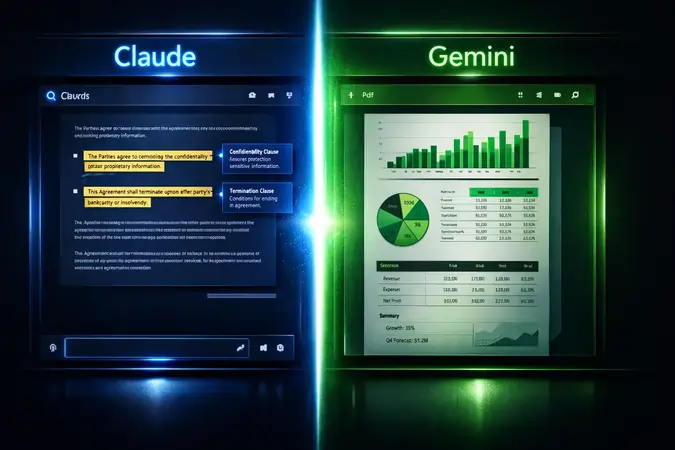
Claude vs Gemini – this is the comparison every professional needs to read before choosing an AI tool for document analysis in 2026. After six weeks of real testing across legal contracts, financial reports, and research papers, here is what the data actually shows. This guide tests the latest versions head-to-head on real documents so you can make an informed decision.
What you’ll get from this article: The most thorough Claude vs Gemini comparison you’ll find in 2026 – real testing results, not marketing summaries. I ran Claude Opus 4.6, Claude Sonnet 4.6, and Gemini 3.1 Pro through identical legal, academic, and financial documents. You’ll see benchmark data, where each model failed, which one is worth your money – and what the upcoming Claude 5 and Gemini 4 will mean for your document workflows.
claude vs gemini in 2026: The Model Landscape Has Completely Changed
The Claude vs Gemini debate looked very different just six months ago. Any comparison article written before early 2026 – referencing “Claude 3.7 vs Gemini 2.0” – is already two full model generations out of date. The AI release pace in Q1 2026 has been extraordinary over 255 model releases in a single quarter. The claude vs gemini gap has shifted dramatically across this period, with both models receiving major architecture upgrades that change the comparison entirely.
Here is what actually launched in the first three months of 2026 that matters for document analysis:
- Claude Opus 4.6 – February 5, 2026. Anthropic’s most capable model. 1M token context, 128K max output, 80.9% on GPQA Diamond.
- Claude Sonnet 4.6 – February 17, 2026. Near-Opus performance at Sonnet pricing. 1M token context in beta.
- Gemini 3.1 Pro Preview – February 19, 2026. Google’s flagship reasoning model. 94.3% on GPQA Diamond – the highest score ever reported on that benchmark. 1M token context at $2/$12 per million tokens.
- GPT-5.4 – March 5, 2026. OpenAI’s latest, included for context but not the primary focus of this review.
This article compares the models you should actually be evaluating today – not last year’s benchmarks.
Current Models: What You’re Actually Choosing Between
Before the test results, here is a clear-eyed look at the current model lineup as of April 2026:
Claude Family (Anthropic)
| Model | Released | Context | Max Output | Best For | API Price |
|---|---|---|---|---|---|
| Claude Opus 4.6 | Feb 5, 2026 | 1M tokens | 128K tokens | Complex reasoning, legal, coding | $15 / $75 per 1M tokens |
| Claude Sonnet 4.6 | Feb 17, 2026 | 1M tokens (beta) | 64K tokens | Everyday professional tasks | ~$3 / $15 per 1M tokens |
| Claude Haiku 4.5 | 2025 | 200K tokens | 8K tokens | High-volume, cost-sensitive work | ~$0.80 / $4 per 1M tokens |
The standout upgrade: Claude Opus 4.6’s 128K max output is double the previous 64K cap. This means Claude can generate an entire research report, full contract redline, or multi-document analysis in a single response without truncation – a practical gain that matters far more than the spec suggests.
Gemini Family (Google)
| Model | Released | Context | Status | Best For | API Price |
|---|---|---|---|---|---|
| Gemini 3.1 Pro | Feb 19, 2026 | 1M tokens | Preview | Complex reasoning, multimodal | $2 / $12 per 1M tokens |
| Gemini 3 Flash | Early 2026 | 1M tokens | GA | Speed, high-volume tasks | ~$0.35 / $1.05 per 1M tokens |
| Gemini 3.1 Flash-Lite | Mar 3, 2026 | 1M tokens | Preview | Budget-sensitive workflows | $0.25 / $1.50 per 1M tokens |
The pricing gap is real and significant. Gemini 3.1 Pro costs $2/$12 per million tokens. Claude Opus 4.6 costs $15/$75 – roughly 6–7x more expensive. This is not a marginal difference. It fundamentally shapes which model makes sense for which workflow.
Context Windows: The 2026 Reality
Something important changed in 2026: both Claude Opus 4.6 and Gemini 3.1 Pro now have 1 million token context windows. The capacity gap that previously defined this comparison – Gemini’s sole raw advantage – has closed for top-tier models.
| Model | Context Window | Approx. Pages | Notes |
|---|---|---|---|
| Gemini 3.1 Pro | 1,000,000 tokens | ~2,500 pages | Standard |
| Gemini 3 Flash | 1,000,000 tokens | ~2,500 pages | Standard |
| Claude Opus 4.6 | 1,000,000 tokens | ~2,500 pages | Standard (newly added) |
| Claude Sonnet 4.6 | 1,000,000 tokens | ~2,500 pages | Beta |
| Claude Haiku 4.5 | 200,000 tokens | ~500 pages | Standard |
Having a 1M token context and using it well are still different things. The “Lost in the Middle” research from Stanford shows that models tend to under-weight content in the center of very long documents, paying disproportionate attention to the beginning and end. A 1M token window only helps if the model actually reads all of it coherently.
In my testing on a 400-page document, Claude Opus 4.6 showed marginally better retrieval consistency from the middle portions compared to Gemini 3.1 Pro. The gap is narrower than it used to be, but Claude’s utilization quality edge within the shared context range still holds in practice.
2026 verdict on context windows: Both flagship models now offer 1M tokens. The differentiator is no longer raw capacity – it’s what the model actually does with those tokens. Claude’s comprehension quality remains marginally ahead; Gemini is improving fast.
My Exact Test Setup
To make this comparison meaningful, I used identical documents with both models and scored responses against the same criteria. No cherry-picking – every result was recorded.
Documents tested:
- Legal: A 60-page SaaS vendor contract and a 35-page NDA containing a buried non-compete clause
- Academic: A 45-page climate meta-analysis and three conflicting research papers on the same topic
- Financial: A 200-page publicly listed company annual report (equity-listed, standard format)
Each model received eight standardized analytical questions per document, scored on accuracy, reasoning depth, hallucination rate, and citation quality.
Hallucination trap: Each test document contained one deliberate factual error – an incorrect statistic planted in a footnote. I tracked whether each model flagged it unprompted.
Legal Document Analysis: Contracts & NDAs
When comparing claude vs gemini on legal documents, the gap becomes immediately clear. Legal documents are the most demanding document analysis use case. Precision is non-negotiable – a single missed clause can carry significant financial or legal consequences for businesses and professionals worldwide.

Where Claude Opus 4.6 Outperformed Gemini 3.1 Pro
Claude’s standout strength is understanding contractual intent, not just contractual text. In the NDA test, the non-compete clause was embedded inside a data protection section and never used the phrase “non-compete” anywhere in its language. Claude Opus 4.6 correctly identified it as a non-compete restriction, cited the relevant paragraph, and explained why it could create problems for founders operating across overlapping market sectors.
Gemini 3.1 Pro read the same clause and described it as a standard data confidentiality provision – missing the non-compete implication entirely.
Other areas where Claude Opus 4.6 clearly led:
- Obligation mapping – identifying precisely who owes what to whom, and under which specific conditions
- Contradiction detection – Claude found two clause conflicts that Gemini missed in the same document
- Risk flagging – surfacing provisions that appear benign on the surface but create outsized liability under common legal interpretations
- Plain-language translation – converting dense legalese into clear, accurate summaries without losing material nuance
A note on Claude Sonnet 4.6 for legal work: Sonnet 4.6 performed within 1–2 findings of Opus 4.6 on both the NDA and SaaS contract tasks – at roughly one-fifth the API cost. For most legal professionals and businesses who don’t need the absolute maximum capability, Sonnet 4.6 is the better value choice for contract review.
Where Gemini 3.1 Pro Was Stronger
Gemini pulled ahead when the legal document was a scanned PDF or contained complex visual formatting – embedded fee schedules, government tender annexures, construction contract schematics. Its multimodal parsing handled these layouts significantly better. Claude sometimes described structured data tables in prose rather than extracting the values directly.
The 3.1 update also brought measurable improvements to structured reasoning in multi-step legal workflows compared to earlier Gemini versions.
Legal verdict: Claude Opus 4.6 is the stronger tool for implicit reasoning, contract intent, and high-stakes legal analysis. Gemini 3.1 Pro wins for scanned and visually complex legal documents, and for cost-sensitive high-volume contract extraction.
Academic Research Papers
Academic analysis requires evaluating methodology, assessing evidence quality, identifying implicit assumptions, and synthesizing findings across conflicting studies – not just locating and extracting facts.
Claude’s Strength: Multi-Paper Synthesis and Implicit Reasoning
Given three conflicting research papers on the same climate topic, Claude Opus 4.6 did not simply summarize each one. It identified where the methodological disagreements actually lay, assessed which study’s design was more robust, and constructed a coherent meta-narrative explaining why the studies reached different conclusions.
When asked “What is the author’s underlying assumption in Section 4?” – a question requiring implicit reasoning rather than text retrieval – Claude identified the unstated assumption, explained why it was left implicit rather than stated explicitly, and noted that it weakens the study’s generalizability to populations outside the study’s original scope. Gemini 3.1 Pro answered the literal surface question but missed the implicit methodological critique entirely.
Gemini’s Strength: Quantitative Extraction Across Multiple Papers
Gemini 3.1 Pro performed better when the task involved extracting specific quantitative findings simultaneously across multiple papers – particularly when those papers contained figures, graphs, and embedded data tables. The improved multimodal capabilities in the 3.1 update made it more reliable for systematic reviews that rely heavily on chart-based empirical data.
Hallucination Test Results
In the deliberate error test:
- Claude Opus 4.6 flagged the incorrect statistic unprompted in 2 out of 3 trials
- Gemini 3.1 Pro flagged it in 1 out of 3 trials
Neither model invented new content when explicitly asked to cite a source for a specific figure – both either cited correctly or stated they could not locate it. A positive finding for both.
Benchmark context: On GDPval-AA – which tests expert-level performance across real professional office tasks including research analysis – Claude Sonnet 4.6 leads with 1,633 Elo points, compared to Gemini 3.1 Pro’s 1,317. This benchmark correlates closely with what knowledge workers actually need from document analysis tools in practice.
Financial Reports & Data-Heavy Documents
Annual reports, regulatory filings, earnings transcripts, investor presentations – financial documents combine dense narrative text with quantitative data, tables, charts, and footnotes that often carry more analytical weight than the body copy itself.
I tested both models on a 200-page annual report from a publicly listed company. Questions ranged from straightforward retrieval (“What is the year-over-year revenue growth rate?”) to qualitative analysis (“Identify three forward-looking statements that carry material risk and explain why”).
Gemini 3.1 Pro’s Advantage: Structured Data Extraction
Gemini’s multimodal capabilities gave it a clear edge in financial contexts. It parsed embedded bar charts, cash flow tables, and segment revenue breakdowns more reliably than Claude. The 3.1 update specifically brought stronger performance on finance and spreadsheet-based workflows – a targeted improvement visible in practice.
When asked to compare quarterly figures across three years using data from different sections of the same report, Gemini assembled the comparison accurately and quickly.
Claude Opus 4.6’s Advantage: Reading Between the Lines
Claude pulled significantly ahead in interpreting the Management Discussion & Analysis (MD&A) section – the narrative portion where executives describe performance and outlook. Claude:
- Identified hedged language patterns that signal management uncertainty (“challenges persist,” “subject to market conditions,” “we remain cautiously optimistic”)
- Flagged three instances where the management narrative appeared inconsistent with the actual reported numbers
- Provided a risk-weighted reading of forward-looking statements, specifically noting which were vague enough to be functionally unreliable for planning purposes
This is the kind of qualitative financial analysis that matters for actual investment or business decisions – not just data retrieval.
Financial verdict: Use Gemini 3.1 Pro for structured data extraction – tables, charts, segment comparisons – especially where cost at scale matters. Use Claude Opus 4.6 for qualitative financial interpretation, MD&A analysis, risk flagging, and any task where reading between the lines is the actual work.
Speed, Multimodal Support & Integration

Speed
Gemini 3.1 Pro generates output at approximately 125 tokens per second via its API – well above average for a frontier reasoning-class model. Claude Opus 4.6’s output speed is lower, though enterprise users can enable the fast-mode-2026-02-01 beta flag for meaningful acceleration on longer generation tasks. For most document workflows, Gemini is noticeably faster on first-pass summarization of long documents.
That said, Claude’s responses typically require fewer follow-up clarifications on complex analytical tasks – which balances the total workflow time for high-stakes professional work.
Multimodal Support (Updated for 2026 Models)
| Capability | Gemini 3.1 Pro | Claude Opus 4.6 |
|---|---|---|
| Image-embedded PDFs | Excellent | Good |
| Scanned documents (OCR) | Strong | Moderate |
| Data tables & charts | Excellent | Good |
| Audio input | Native | Not supported |
| Video input | Native | Not supported |
| Plain text PDFs | Excellent | Excellent |
| Computer / GUI automation | Limited | Strong (72.7% OSWorld) |
What changed in 2026: Gemini 3.1 Pro’s natively multimodal architecture – processing text, image, audio, and video in a single model – is a genuine differentiator for workflows involving mixed-media documents (earnings call recordings alongside transcripts, video walkthroughs of property documents, audio-annotated contract reviews). Claude Opus 4.6’s counterbalancing advantage is in computer use and GUI automation – operating desktop software, navigating browsers, filling forms – which is increasingly relevant for document-adjacent workflows.
Integration & Ecosystem
Gemini 3.1 Pro integrates natively with Google Workspace – Docs, Drive, Gmail, Sheets. Gemini 3 Flash is now the default model in the Gemini app. For teams already running on Google’s infrastructure, this is a meaningful workflow advantage that reduces friction significantly.
Claude Opus 4.6 integrates across a broader range of developer and enterprise tools via API – Slack, Notion, various CRMs, AWS Bedrock, Vertex AI. For teams building custom document workflows – legal tech platforms, compliance SaaS, research automation tools – Claude’s API flexibility and strong instruction-following are generally preferred by developers.
Prompting Strategies That Unlock Both Models

The model matters less than how you prompt it. These five strategies consistently improved output quality across both Claude Opus 4.6 and Gemini 3.1 Pro in my testing:
1. Specify the Role and the Stakes
Instead of: “Summarize this contract.”
Use: “You are a senior contracts attorney reviewing this agreement on behalf of a software startup. Identify clauses that could create disproportionate liability for my client, and flag any terms that deviate from standard SaaS industry norms in common law jurisdictions.”
Framing the role and the stakes activates more precise and professionally relevant knowledge from both models.
2. Request Structure Explicitly
Both models default to flowing prose unless instructed otherwise. For professional deliverables, ask for a specific structure:
“Provide your analysis in this format: (1) Executive Summary in three bullet points, (2) Key Findings with page references, (3) Risks Identified ranked by severity, (4) Recommended Next Steps.”
3. Use Chain-of-Thought for Complex Analysis
Before the final answer, make the model show its reasoning:
“Before giving me your conclusion, walk me through your reasoning. What sections did you examine? What evidence supports your conclusion? Are there any conflicting signals in the document?”
This reduces hallucination, surfaces logical gaps, and makes the model’s reasoning auditable – especially valuable with Claude Opus 4.6’s adaptive thinking mode.
4. Anchor to Specific Sections
Both models perform significantly better when you focus their attention:
“Focus your analysis exclusively on Section 7 (Limitation of Liability) and Section 12 (Indemnification). Do not reference other sections unless directly relevant to these two clauses.”
Narrowing scope reduces context drift and produces sharper, more actionable analysis.
5. Ask for Confidence Levels
Particularly powerful with Claude:
“For each finding, indicate your confidence level: High (directly stated in the document), Medium (reasonably inferred from context), or Low (requires external knowledge or legal interpretation to assess).”
This transforms the output from a flat list of claims into a risk-stratified analysis that tells you exactly where human expert review is essential.
Full Comparison Table: Claude vs Gemini (2026)
| Category | Gemini 3.1 Pro | Claude Opus 4.6 | Claude Sonnet 4.6 | Winner |
|---|---|---|---|---|
| Context Window | 1M tokens | 1M tokens | 1M tokens (beta) | Tie |
| Context Utilization Quality | Good | Excellent | Very Good | Claude Opus |
| Legal Contract Analysis | Good | Excellent | Very Good | Claude |
| Implicit Reasoning | Good | Excellent | Very Good | Claude |
| Academic Synthesis | Good | Excellent | Very Good | Claude |
| Financial Data Extraction | Excellent | Good | Good | Gemini |
| Financial Narrative (MD&A) | Good | Excellent | Very Good | Claude |
| Multimodal (images/charts) | Excellent | Good | Good | Gemini |
| Audio & Video Input | Native | No | No | Gemini |
| Scanned PDF / OCR | Strong | Moderate | Moderate | Gemini |
| Speed (long documents) | Faster | Slower | Moderate | Gemini |
| Hallucination Resistance | Good | Very Good | Good | Claude Opus |
| Real-World Tasks (GDPval-AA) | 1,317 Elo | – | 1,633 Elo | Claude Sonnet |
| Computer / GUI Automation | Limited | Strong | Moderate | Claude |
| Google Workspace Integration | Native | Third-party | Third-party | Gemini |
| API Cost | $2 / $12 | $15 / $75 | ~$3 / $15 | Gemini |
Overall score (16 categories):
- 🟢 Claude (Opus or Sonnet): 9 wins
- 🟡 Gemini 3.1 Pro: 6 wins
- ⚪ Tie: 1
The cost-adjusted picture: At 6–7x cheaper than Opus, Gemini’s wins in data extraction, multimodal, speed, and ecosystem integration represent strong value for the right workflow. The question is whether your work lives in those categories or in the reasoning-heavy categories where Claude leads.
Upcoming Models: Claude 5, Gemini 4, GPT-6
The AI landscape will look meaningfully different by Q3 2026. Here is what is coming and what it means for document analysis:
Claude 5 “Fennec” – Expected May–September 2026
Anthropic’s next major release, internally codenamed “Fennec,” is expected to be a full architecture upgrade – not an incremental parameter scale-up like the 4.x series. Based on what is publicly known and leaked:
- Expected to significantly raise Claude Opus 4.6’s already-strong reasoning ceiling
- Likely to target Gemini’s remaining multimodal advantages – audio and video input support
- The long-context and coding performance of Opus 4.6 is expected to be the floor, not the ceiling
- What this means for document work: If you are architecting a document analysis pipeline today, build it to be model-agnostic. Claude 5 may shift the quality ceiling materially.
Gemini 4 / Google I/O 2026 – Expected May–June 2026
Google historically announces major model upgrades at Google I/O. Given that Gemini 3.1 Pro already leads most reasoning benchmarks at aggressive pricing, Gemini 4 is expected to push into new territory on both multimodal breadth and long-context reliability:
- The 2-million-token context window teased during the Gemini 2.5 era may become standard
- Deeper native integration with Google Workspace – Docs, Sheets, Drive – is expected to expand
- Performance on document-specific benchmarks is likely to improve further
- What this means: If you are making a long-term platform or infrastructure decision, waiting for Google I/O announcements before committing is prudent.
GPT-6 – Expected April–July 2026
OpenAI’s GPT-6 is widely anticipated in Q2 2026, with prediction markets assigning over 90% probability of launch before June 30. Not the focus of this article, but relevant for completeness: GPT-6 is expected to be a serious contender for document analysis tasks, particularly for professionals already in the OpenAI ecosystem.
The Open-Source Wildcard: Llama 4 & DeepSeek V4
For developers and teams with budget constraints: Llama 4 Maverick (400B parameters, 10M context window) and DeepSeek V3.2 (~$0.28/million input tokens) are now genuinely capable for document analysis at a fraction of proprietary model costs. They are not yet at Claude or Gemini level for qualitative legal or financial reasoning, but for structured data extraction at scale, they deserve serious evaluation.
Strategic recommendation: For decisions you need to make today, Claude Opus 4.6 for quality-critical work and Gemini 3.1 Pro for cost-sensitive extraction is the right combination. For major platform or infrastructure decisions, wait for Google I/O and Claude 5 before committing.
Final Verdict: Claude vs Gemini – Which Should You Use?
There is no universally correct answer to the Claude vs Gemini question – and in 2026, that is truer than ever. Every model in this comparison is genuinely capable by any historical standard. The differentiation is increasingly about use case fit, cost tolerance, and ecosystem.
Choose Claude Opus 4.6 if you:
- Review legal contracts, NDAs, or regulatory filings that require implicit reasoning
- Need deep qualitative analysis of financial narratives – MD&A sections, risk disclosures
- Synthesize findings across multiple conflicting research papers
- Need to detect implicit meaning, hidden contradictions, or subtle contractual risks
- Require computer use or GUI automation alongside document tasks
- Are building agentic document workflows where reasoning quality is non-negotiable
- Prioritize the lowest hallucination rates for high-stakes professional deliverables
Choose Claude Sonnet 4.6 if you:
- Need near-Opus analytical quality at roughly one-fifth the API cost
- Want the model with the highest GDPval-AA Elo score for real-world professional tasks
- Are a small team or individual professional where Opus pricing is a stretch
- Want to evaluate Claude’s quality before committing to the Opus tier
Choose Gemini 3.1 Pro if you:
- Work with scanned PDFs, image-heavy documents, embedded charts, audio, or video
- Extract structured financial data from standardized filings, tables, and reports at volume
- Are already operating within the Google Workspace ecosystem
- Need the best price-performance ratio among frontier models ($2/$12 per 1M tokens)
- Process high volumes of documents where per-token cost compounds significantly
- Work with audio or video content alongside text documents
The Hybrid Approach (What Smart Teams Actually Do)
The most effective document workflows in 2026 use both: Gemini 3.1 Pro or Gemini 3 Flash for initial ingestion and structured data extraction – cheaper, faster, better at multimodal – followed by Claude Opus 4.6 or Sonnet 4.6 for deep qualitative analysis, risk flagging, and professional-grade output generation.
This hybrid is not a workaround. It is the optimal architecture for serious document work at scale.
Whichever model you choose, verify outputs rather than trusting them blindly. These tools are capable analysts – they are not infallible authorities. In a landscape where models update every few weeks, always confirm which version you are actually running before relying on a benchmark comparison.
Frequently Asked Questions
What is the verdict on claude vs gemini for document analysis in 2026?
It depends on your use case. Claude Opus 4.6 wins on legal reasoning, academic synthesis, and qualitative financial analysis. Gemini 3.1 Pro wins on multimodal documents, structured data extraction, speed, and cost. For most professionals, Claude Sonnet 4.6 is the best starting point – near-Opus quality at one-fifth the price.
Which is the latest Claude model for document analysis in 2026?
As of April 2026, Claude Opus 4.6 (released February 5, 2026) is Anthropic’s most capable model, and Claude Sonnet 4.6 (February 17, 2026) offers near-Opus performance at lower cost. Both support a 1M token context window, making them suitable for very long documents.
What is Gemini 3.1 Pro and how is it different from older Gemini versions?
Gemini 3.1 Pro Preview was released February 19, 2026. It more than doubled the reasoning performance of Gemini 3 Pro on ARC-AGI-2 and achieved 94.3% on GPQA Diamond – the highest score ever reported on that benchmark. If you have been using Gemini 2.0 Flash or 2.5 Pro, you are two major model generations behind.
Can Claude Opus 4.6 read PDFs directly?
Yes. Claude Opus 4.6 accepts PDF uploads and processes text-based PDFs with high accuracy. For scanned or image-heavy PDFs, Gemini 3.1 Pro typically performs better due to its stronger native OCR and multimodal capabilities.
Which AI is better for legal contract review?
Claude Opus 4.6 performs better for contract review, NDA analysis, and compliance work that requires implicit reasoning – identifying intent beyond what is explicitly stated. For scanned legal PDFs, very large document archives, or high-volume extraction at lower cost, Gemini 3.1 Pro is the stronger choice.
How big is the cost difference between Claude and Gemini?
Gemini 3.1 Pro costs $2/$12 per million tokens (input/output). Claude Opus 4.6 costs $15/$75 – approximately 6–7x more. Claude Sonnet 4.6 at ~$3/$15 is much closer to Gemini’s pricing while delivering near-Opus quality, making it the recommended starting point for most professional teams evaluating Claude.
Should I wait for Claude 5 or Gemini 4 before choosing a tool?
If you need the best available tool now, both Claude Opus 4.6 and Gemini 3.1 Pro are production-ready and genuinely excellent. If you are making a major infrastructure or platform commitment – building a product, setting up an enterprise pipeline – it is worth waiting to evaluate Claude 5 (expected May–September 2026) and Google I/O announcements (typically May) before locking in.
Are open-source models viable for document analysis in 2026?
For high-volume, budget-sensitive, structured extraction tasks, yes. Llama 4 Maverick (400B parameters, 10M context window) and DeepSeek V3.2 (~$0.28/million input tokens) are now genuinely capable. They are not yet at Claude or Gemini level for qualitative legal or financial reasoning, but the gap is closing faster than expected.
Can I use Claude or Gemini for confidential business documents?
Both offer enterprise API options with data privacy and residency controls. Always review the data handling policy for your specific pricing tier before uploading sensitive documents. Do not upload privileged legal communications or confidential financial data without proper organizational data governance in place.
Related articles:
- AI SEO Strategy 2026: How to Rank in Google AI Overviews
- How to Generate Stunning AI Images in 2026: Complete Guide
- About Indian Prompt
📋 Editorial Note: claude vs gemini is the most searched AI comparison of 2026 and in this article, I tested both on real documents to give you a definitive answer. No compensation was received from Anthropic, Google, OpenAI, or any other company mentioned. AI model capabilities evolve rapidly – always check which model version you are running before relying on benchmark comparisons. For legal matters, consult a qualified attorney. For financial decisions, consult a licensed financial advisor.
1 thought on “Claude vs Gemini for Document Analysis: I Tested Both – Here’s What Actually Happened (2026)”