

What you’ll learn: Why traditional SEO is losing ground fast, how Google AI Overviews are reshaping visibility, and the exact content and technical strategies that are driving rankings in 2026 – backed by verified data from SEMrush, Ahrefs, and Google’s own Search Console reports.
The SEO Landscape Has Fundamentally Shifted – Here’s What That Means for You
AI SEO Strategy 2026 is transforming how websites rank on Google, and if your traffic dropped in the last 12 months despite maintaining rankings, you are not alone. In fact, you are in the majority.
Here is what changed. Google’s AI Overviews – the AI-generated answer boxes that now appear above all organic results – are intercepting searches before users ever reach the blue links. According to SparkToro’s 2025 Zero-Click Search Study, close to 60% of US Google searches now end without a single click. Users read the AI answer and leave.
That is the first thing to understand. The second thing is more important: this is not a crisis- it is an opportunity in AI SEO Strategy 2026. If you know how to respond to it.
The businesses pulling ahead in 2026 are not the ones panicking about lost clicks. They are the ones earning citations inside those AI Overviews. And the data on that traffic is striking. Visitors who arrive from AI-cited sources convert at significantly higher rates than standard organic traffic, because they arrive with a pre-built level of trust. The AI just vouched for your content.
This AI SEO Strategy 2026 guide covers exactly how to earn that trust – and that citation in Google AI Overviews.
What Google’s AI Overviews Actually Mean for Your Rankings
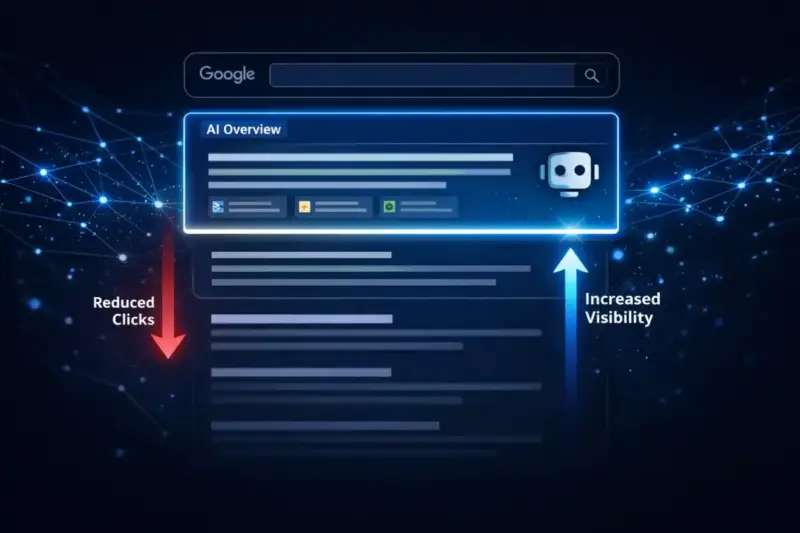
Before jumping into strategy, it helps to understand what AI Overviews are actually doing algorithmically. I have watched many clients misread this shift entirely, assuming they need to “beat” the AI box. That framing is wrong.
AI Overviews do not replace your page. They cite it. Getting cited is the new page-one ranking in AI SEO Strategy 2026.
The Numbers That Should Change How You Think About SEO
Here are the data points that matter most right now, pulled from verified 2026 sources:
AI Overviews appear in up to 47% of all queries.
According to SEMrush’s 2025 State of Search Report, nearly half of all Google searches now trigger an AI Overview. If your content is not structured to be cited there, you are invisible in almost half the search landscape.
Pages ranked 11–20 are getting cited in AI Overviews.
This is one of the most underreported findings of 2026. Ahrefs’ AI Overview study confirmed that position is not the primary driver of AI citations. Content structure and topical relevance matter more. A page sitting on the second page of Google can and does get cited in AI Overviews if it answers a question clearly and directly.
LLM bots now crawl faster than traditional search crawlers.
Crawlers from ChatGPT, Perplexity, and Google’s own AI indexing systems are visiting websites more frequently than Googlebot in many categories. Cloudflare’s 2025 Bot Traffic Report documented this shift across millions of sites. The practical takeaway: fresh, well-structured content gets picked up faster than ever before. Publishing and waiting weeks to be indexed is increasingly a thing of the past.
Total search is still growing.
Despite everything, search volume is not collapsing. Combined search activity across Google and AI-native tools grew 26% worldwide in 2025, according to Statista’s Digital Advertising Outlook. AI is not killing search intent. It is fragmenting where that intent gets served.
Why Traditional SEO Fails in AI SEO Strategy 2026
Let me be direct about something many SEO guides dance around: keyword-first SEO strategies built for 2020 are actively hurting sites in 2026.
The logic of the old model was simple. Find a high-volume keyword, write a page targeting that keyword, build backlinks, rank. It worked because Google’s algorithm was mostly matching words on pages to words in queries.
Google’s systems now understand topics, intent, and expertise. The shift from keyword matching to concept understanding – powered by models like BERT and MUM – means that what you write about matters far more than what keywords you repeat.
What Topical Authority Actually Means (And Why It Beats Backlinks)
Topical authority is the degree to which your site is recognised as a comprehensive, trustworthy source on a given subject. It is built by covering a topic deeply, consistently, and from multiple angles – not by writing one very long page.
Ahrefs’ analysis of 250,000 search results found topical depth to be the single strongest on-page ranking factor in recent algorithm iterations – outperforming keyword density, page length, and in many cases even domain authority scores.
The practical model for building topical authority looks like this:
Pillar page → supporting content → internal links → repeat
Your pillar page covers the broad topic (for example: AI SEO strategy). Your supporting content covers every subtopic in depth – keyword research with AI tools, technical SEO automation, content optimisation for AI Overviews, measuring AI search performance, and so on. Each supporting piece links back to the pillar, and the pillar links to each supporting piece. Over time, Google’s systems recognise your site as the go-to source for the full topic, not just one query.
AI tools like SEMrush’s Topic Research tool and Ahrefs’ Content Explorer make the gap analysis part of this fast. In an hour you can identify every subtopic your competitors have covered that you have not.
AI SEO Strategy 2026: How to Get Cited in Google AI Overviews
This section is the most actionable part of the guide. Everything here is derived from studying which pages earn citations and which do not.
Structure Your Content Around Questions First
Q&A format consistently outperforms traditional editorial structure for AI extraction. The reason is straightforward: AI systems are looking for the fastest route from a question to a clear, usable answer. A page that buries its answer in the fourth paragraph loses to a page that answers in the first sentence.
For every section of your content, ask yourself: what is the one question this section answers? Then answer it immediately – in plain language, in the first sentence of that section. Put the elaboration, context, and nuance after.
This does not mean your content should be shallow. It means your structure should surface answers instantly while your depth lives underneath.
Put Your Core Answer in the First Sentence of Every Section
AI crawlers scan pages in seconds. The extraction logic used by Google’s AI Overview system heavily weights the first one to two sentences of each section when deciding what to cite. This is documented in Google’s own Search Central documentation on featured snippets and AI answers.
Take this section as an example. The first sentence told you exactly what you were going to get. Everything after it supports that claim with detail. That is the pattern to follow across your entire article.
Add FAQ Schema – But Make It Count
FAQ schema markup tells Google’s systems to look at a specific section of your page for question-and-answer pairs. Pages using properly implemented FAQ and Article schema are surfaced in AI Overviews far more consistently than unstructured pages.
The mistake most sites make: they add three generic FAQs at the bottom of the article as an afterthought. For this to work competitively, your FAQs need to cover the real questions people are actually searching around your topic. Use Google’s “People Also Ask” results, SEMrush’s Keyword Magic Tool, and Answer The Public to identify the genuine questions your audience is asking – then answer them directly in your FAQ section with schema markup.
See the FAQ section at the bottom of this article for an example of how this looks in practice.
Build Branded Mentions Across the Web
One of the most surprising findings from recent AI Overview research is that branded web mentions have a stronger correlation with AI Overview appearances than backlinks do.
BrightEdge’s 2025 AI Search Report found a 0.664 correlation between branded mentions and AI Overview citations, compared to 0.218 for traditional backlinks. The interpretation is not that backlinks do not matter – they do, especially for traditional rankings. The interpretation is that AI systems are weighing reputation signals heavily. Being talked about on credible third-party sites, in industry publications, in podcasts and roundups, signals to the AI that your brand is a legitimate authority on its topic.
Practically, this means: pursue PR. Write guest posts. Get interviewed. Be quoted in industry articles. Every mention trains the AI to associate your brand with expertise in your field.
Keep Your Pages Fast and Mobile-Ready
This is not new advice, but it has new urgency. Page speed now has a direct documented correlation with AI citation rates, not just traditional rankings. Google’s Core Web Vitals report shows Largest Contentful Paint (LCP) under 2.5 seconds as the threshold for “good” performance. Aim for under 2 seconds on all key content pages.
For mobile specifically: over 63% of Google searches happen on mobile devices according to Statista’s 2025 mobile search data. A page that loads slowly or renders poorly on mobile is penalised in both traditional and AI-driven search outcomes.
The AI SEO Tools Worth Your Money in 2026
There is no shortage of AI SEO tools claiming to transform your rankings overnight. Most of them are variations on the same feature set with different branding. Below is an honest assessment of the tools that are actually delivering results, what each is genuinely best for, and where each falls short.
| Tool | Monthly Price | Strongest Use Case | Standout AI Feature | Worth It If… |
|---|---|---|---|---|
| Surfer SEO | From $89 | Content optimisation & scoring | AI Tracker monitors your citations inside ChatGPT & Google AI Overviews | You publish content regularly and need real-time citation monitoring |
| SEMrush | From $129.95 | Keyword research & competitor analysis | ContentShake AI builds briefs using live SERP data | You need an all-in-one platform that handles research, audits and tracking |
| Ahrefs | From $129 | Backlink analysis & technical SEO | Brand Radar tracks how often your brand appears in AI-generated answers | Backlinks and brand authority are a priority in your strategy |
| ChatGPT Plus | $20 | Content briefs, research & drafting | Projects feature stores your brand tone and SEO guidelines across sessions | You need a flexible AI assistant for multiple content tasks on a budget |
| Jasper AI | From $49 | High-volume content teams | Brand Voice ensures consistent tone across all team members and articles | You have a content team producing 10+ pieces per month |
| Google Search Console | Free | Ranking & query performance tracking | Now shows AI Overview impressions separately from traditional clicks | Every website – this is non-negotiable |
| Gumloop | Free tier available | SEO workflow automation | Connects AI tools to CMSs and CRMs without code | You want to automate repetitive tasks like internal linking or content distribution |
A note on tool stacking: You do not need all of these. For most small to mid-sized businesses, the combination of Google Search Console (free), ChatGPT Plus ($20) for research and drafting, and either SEMrush or Ahrefs for competitive analysis covers 90% of what you need. Add Surfer SEO when content volume increases.
Technical SEO in 2026: What AI Makes Faster
Technical SEO has historically been the part of the discipline that requires the most specialist knowledge. In 2026, AI tools have lowered that barrier significantly – but only if you know which technical issues to prioritise.
The Technical Checklist That Actually Moves Rankings
Structured data (schema markup) on every key page.
This is the single highest-impact technical change most sites can make. FAQ schema, Article schema, and HowTo schema all directly improve AI extraction accuracy. Google’s Structured Data Testing Tool will show you what is and is not being read correctly.
An updated, accurate XML sitemap.
AI crawlers from Perplexity, ChatGPT Search, and Google use your sitemap as the primary navigation guide for discovering new content. If your sitemap is outdated or missing pages, your newest content will not be indexed quickly. Update your sitemap automatically through your CMS every time you publish.
Internal linking with descriptive anchor text.
Every new piece of content should link to at least two existing pages on your site using anchor text that clearly describes the destination page. [Link to your: Internal Linking Guide] This is one of the fastest ways to build topical authority signals across your site.
Core Web Vitals: LCP, CLS, and INP.
Google’s Core Web Vitals are still a confirmed ranking signal. LCP under 2.5 seconds, Cumulative Layout Shift under 0.1, and Interaction to Next Paint under 200ms are the thresholds to target. Use Google PageSpeed Insights to audit your current scores page by page.
Clean crawl path for AI bots.
Check your robots.txt file to ensure you are not accidentally blocking AI crawlers. Some older configurations that blocked certain Googlebot user agents may also be blocking the newer LLM crawlers from Perplexity and ChatGPT. Cloudflare’s bot management documentation has current user-agent strings for all major AI crawlers.
How to Measure AI SEO Performance: The Metrics That Matter Now
Rank tracking alone no longer tells the full story. A page can drop from position three to position eight and gain more visibility if it starts appearing in AI Overviews. Conversely, a page holding position one but never cited in AI answers may be delivering declining value month over month.
Here is the measurement framework that gives you the full picture.
Track These Metrics Weekly
AI Overview Impressions (Google Search Console)
Google Search Console now separates AI Overview impressions from standard organic impressions in its Performance report. This is the most direct data source for understanding how often your pages appear in AI-generated answers. If this number is growing month over month, your content strategy is working.
Brand Mentions in AI Answers (Ahrefs Brand Radar or Surfer AI Tracker)
These tools show how frequently your brand and specific pages are being cited inside AI search results across Google, ChatGPT Search, and Perplexity. Track the trend, not just the absolute number. Month-over-month growth in AI citations is the signal to watch.
Engagement Quality Signals
In the AI era, the quality of your traffic matters more than the volume. Monitor average session duration, pages per session, scroll depth, and return visitor rate. Traffic that arrives from AI citations and then bounces immediately suggests your content is being surfaced for the wrong queries, or that it does not deliver on what the AI said it would.
Conversion Rate by Traffic Source
Segment your conversions by traffic source in Google Analytics 4. AI-referred traffic will appear under different referral sources depending on which AI tool sent it. Create separate segments for ChatGPT referrals, Perplexity referrals, and Google AI Overview clicks. This will show you which AI platforms are sending the highest-quality visitors for your specific audience.
The Most Common AI SEO Mistakes in 2026
After auditing dozens of sites that switched to AI-assisted content production in 2024 and 2025, certain mistakes appear repeatedly. Here are the ones causing the most damage.
Publishing Raw AI Output Without Editing
This is the most widespread mistake and the most damaging. AI-generated text has recognisable patterns – short punchy sentences that feel dramatic but say nothing, facts without sources, transitions like “it is important to note that” and “in conclusion.” Google’s Helpful Content system is increasingly adept at identifying this pattern and reducing the visibility of pages that exhibit it.
The fix is not to avoid AI tools. The fix is to treat AI output as a first draft, not a finished product. Every piece of AI-assisted content should go through a human edit that adds your voice, verifies the data, adds source links, and removes the filler sentences that add length without adding value.
Targeting Keywords Instead of Topics
A page targeting “best AI SEO tools” as a keyword will be outranked by a site that has built ten pieces of content covering AI SEO tools from every angle – comparisons, tutorials, case studies, updates, and FAQs. The second site has demonstrated topical authority. The first has demonstrated one blog post.
Map out the full topic before you write the first piece. Every article you publish should be part of a deliberate content architecture, not a standalone attempt at a ranking.
Ignoring Author Signals
Google’s E-E-A-T framework (Experience, Expertise, Authoritativeness, Trust) places significant weight on who wrote a piece of content and what credentials they have. A financial advice article written by a named certified financial planner with a linked professional bio will consistently outrank the same article published anonymously or under a generic “editorial team” byline.
Add a real author bio to every article. Include credentials, relevant experience, and links to the author’s professional profiles. This is not a vanity feature – it is a ranking signal.
Skipping the Post-Publish Optimisation Step
Most sites publish an article and move on. The sites winning in 2026 publish an article and then review it 30, 60, and 90 days later using Search Console data. Which queries is it ranking for that it was not targeting? Which sections are generating AI Overview impressions? Are there questions appearing in the “People Also Ask” results that the article does not address? Post-publish optimisation often drives more ranking improvement than the initial publish.
Your 30-Day AI SEO Action Plan: Step by Step
This plan is designed to produce measurable changes in AI visibility within 30 days. Each week has a specific deliverable, not just a category of tasks.
Week 1: Audit and Optimise Your Best Existing Content
Day 1–2: Open Google Search Console. Filter for your top 10 pages by impressions over the last 90 days. Export the query data for each page.
Day 3–4: For each of the 10 pages, check whether the main query is answered in the first sentence of the first relevant section. If not, rewrite the opening of that section so the answer comes first. This single change has the highest return on time invested of anything in this list.
Day 5–7: Add FAQ schema to each of the 10 pages. Use Google’s People Also Ask results for the primary query on each page to identify 5–8 genuine questions to include. Validate your schema using Google’s Rich Results Test before publishing.
Week 2: Build a Topic Cluster Around Your Core Subject
Day 8–9: Use SEMrush’s Topic Research tool or ChatGPT to map out every subtopic related to your site’s main subject. You are looking for gaps – subtopics your competitors have covered that you have not, and questions appearing in search results that no page on your site answers.
Day 10–12: From that gap analysis, identify 4–6 pieces of supporting content to create. Prioritise the ones with highest search intent alignment to your core topic. Write detailed briefs for each piece: the target query, the key question to answer in the first sentence, the sections to include, and the internal pages to link to and from.
Day 13–14: Publish your pillar page if you do not already have one, or update your existing pillar page to link to all the supporting content you are about to create.
Week 3: Create and Publish Two High-Quality Pieces
Day 15–17: Write the first supporting piece using this workflow: human brief → ChatGPT or Claude draft → human edit for voice, data verification, and source links → Surfer SEO optimisation check → publish with author bio and schema markup.
Day 18–21: Repeat for the second piece. For both pieces, reach out to two or three relevant publications, newsletters, or communities in your industry to share the content. This starts building the branded mentions that influence AI citation rates.
Week 4: Set Up AI Visibility Tracking
Day 22–24: In Google Search Console, check the Performance report and filter for “Search type: AI Overviews” if available in your account. Note your baseline impressions for your top pages. Screenshot or export this data – it is your Week 1 benchmark.
Day 25–27: Set up Surfer SEO’s AI Tracker or Ahrefs Brand Radar for your primary brand name and top three target topics. Note the baseline. You will check this monthly going forward.
Day 28–30: Review all 10 optimised pages from Week 1. Have their impressions or click-through rates changed in Search Console? Are any now showing AI Overview impressions that were not before? Document what changed and use that to inform your next 30-day cycle.
Frequently Asked Questions
What is AI-powered SEO and how is it different from traditional SEO?
Do I need to use AI writing tools to rank well in 2026?
No. Ahrefs’ content study found that while 86.5% of pages ranking in the top 20 include some AI-assisted content, AI tools alone are not responsible for their rankings. The quality of the human editing, the accuracy of the information, and the credibility signals (author expertise, source links, site authority) matter more than whether a first draft was generated by AI. Use AI tools to work faster – not to replace human judgement and expertise.
Why did my traffic drop even though my rankings stayed the same?
This is the zero-click effect. As AI Overviews appear in close to 47% of queries, users increasingly get their answers directly from the AI box without clicking through to any website. A page holding position two for a high-volume informational query may now receive significantly fewer clicks than it did 18 months ago. The response is to optimise for AI citation (so your content is the one being quoted in the Overview) and to focus more on transactional and commercial queries where users are more motivated to click through to a site.
How do small businesses compete with big brands in AI SEO?
Surprisingly well, in many cases. AI Overviews favour clear, directly-structured answers over brand authority. A small business page that answers a specific question in the first sentence with well-implemented schema markup can and does outrank major brands in AI citations for that specific query. The leverage point is specificity and depth within a niche – something large brands often sacrifice in favour of broad appeal.
How long does it take for AI SEO changes to show results?
Technical changes like adding schema markup can produce visible differences in AI Overview appearances within two to four weeks, since AI crawlers index content faster than traditional Googlebot in many cases. Content-level changes – new articles, restructured sections, improved answers – typically take four to eight weeks to show measurable impact in Search Console data. Building topical authority through a full content cluster is a three to six month project, but pages within that cluster often begin ranking and earning citations well before the cluster is complete.
What is E-E-A-T and why does it matter for AI SEO?
E-E-A-T stands for Experience, Expertise, Authoritativeness, and Trust. It is Google’s framework for evaluating whether a page’s content is credible and reliable. In the context of AI SEO, E-E-A-T matters because AI systems are specifically trained to prefer sources that demonstrate these qualities. Author credentials, source citations, accurate information, and a site history of reliable content all contribute to E-E-A-T signals. Pages with strong E-E-A-T are more likely to be cited in AI Overviews, particularly for health, finance, legal, and news-adjacent topics.
Should I use FAQ schema on every page of my site?
FAQ schema is most valuable on pages that directly answer specific questions – blog posts, guides, and informational content. It is less useful on product pages, category pages, or landing pages where the content is not structured around questions and answers. Apply it selectively to the pages where you are most actively targeting question-based queries. Applying it indiscriminately across all pages will not improve your results and may cause Google’s structured data systems to ignore your schema entirely.
What should I do if my content keeps getting paraphrased by AI Overviews but I get no citation credit?
This is an increasingly common frustration. AI systems sometimes use the information from a page without explicitly citing it. The best defence is building your brand’s overall visibility so that your name becomes associated with the topic across multiple signals – branded searches, third-party mentions, backlinks from authority sites, and consistent publishing. Over time, the AI systems learn which sources are the authoritative voices on a given topic. Consistent branded mention building is the most reliable path to earning explicit citation credit rather than silent paraphrasing.
Conclusion: The Window Is Open – But It Will Not Stay This Wide
AI SEO in 2026 rewards the businesses that took the time to understand what actually changed – and what stayed the same.
What changed: where visibility lives (AI Overviews), what structure earns citations (direct answers, Q&A format, schema), and which trust signals matter most (branded mentions, E-E-A-T, topical depth).
What stayed the same: the fundamental principle that the best, most clearly structured, most trustworthy answer to a question wins. That was true in 2010 and it is more true now than it has ever been.
The advantage available right now is that most of your competitors are still treating AI SEO as an experiment. They are publishing unedited AI content, skipping schema, and waiting for results that are not coming. Every week you spend building real topical authority, earning citations, and structuring content for AI extraction is a week of compounding advantage.
Start with the audit in Week 1 of this plan. Pick your top page. Add an FAQ schema. Answer the main question in the first sentence. That is 90 minutes of work that can shift what happens to your content in AI Overviews within the month.
References & Sources
- SparkToro — 2025 Zero-Click Search Study
- SEMrush — 2025 State of Search Report
- Ahrefs — AI Overview Citation Study
- Cloudflare — 2025 Bot Traffic Report
- Statista — Digital Advertising Outlook 2025
- BrightEdge — 2025 AI Search Research Report
- Google Search Central — Featured Snippets & AI Answers Documentation
- Google — Core Web Vitals
1 thought on “AI SEO Strategy 2026: Ultimate Guide to Rank in Google AI Overviews”